2.2 FUNDING INFRASTRUCTURE
Infrastructure will be financed by budget revenues, user charges and debt.
- In the general government sector the principal source of funds for capital expenditure is State taxes and Commonwealth funds. The use of borrowing to fund expenditure is limited because the payment of interest and principal restricts future funding on services.
- The Government's fiscal strategy holds underlying net debt in the general government sector at around 1 per cent of Gross State Product. This will be exceeded in the early years of the next decade with underlying net debt above 2 per cent of Gross State Product. Later in the decade this level of underlying net debt will decline.
- By contrast, borrowing while less restricted, is commercially constrained in the public trading enterprise sector. In this sector a prudent gearing requirement for each enterprise determines the appropriate levels of borrowing in a similar manner to private sector entities.
- Debt is a major source of capital funds for public trading enterprises with the remainder of the capital expenditure in this sector financed mainly through user charges.
- The fiscal strategy aims to provide flexibility to deal with cyclical declines in revenues and the capability to address the range of expenditure pressures set to emerge in the future with a particular focus on the impact of ageing.
- Of the $9.9 billion to be invested in infrastructure in 2006-07, this capital expenditure will be partly funded by some of the increase in State sector underlying net debt of $7.6 billion.
- Over the four years to 2009-10, total State expenditure will be $41.3 billion and partly funded by some of the increase in total State sector underlying net debt of $19.6 billion.
INFRASTRUCTURE GROWTH OF 4.6% AVERAGE P.A .OVER THE DECADE IS SUSTAINABLE
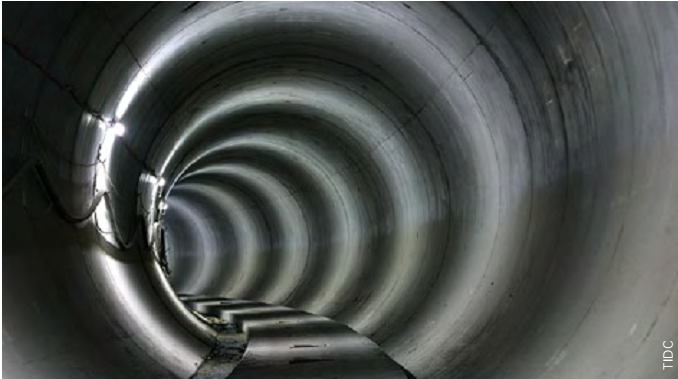
EPPING TO CHATSWOOD RAIL LINK UNDER CONSTRUCTION