Project Maturity Scores
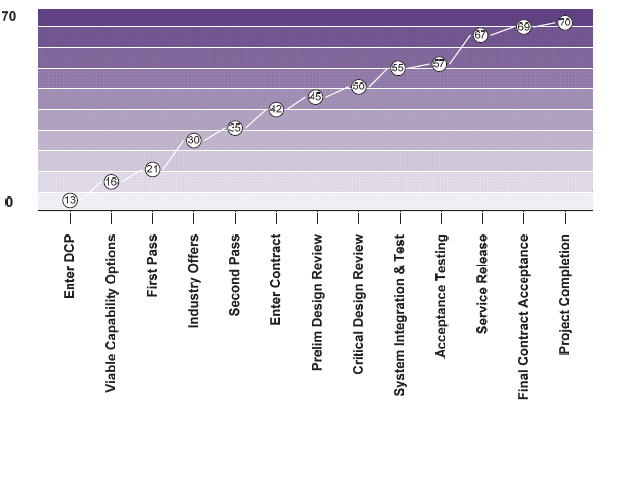
1.37 The DMO's Project Maturity Score quantifies the maturity of a project by way of an objective score based on the project managers' judgement at defined milestones in its capability development and acquisition phases. This score is then compared against an ideal or benchmark score for that milestone. A project's maturity is assessed at 13 milestones across its lifecycle and for each of these milestones the ideal or benchmark condition is represented by a benchmark score as shown in Figure 1.1.
1.38 The Project Maturity Score comprises a matrix of seven attributes (Cost, Requirements, Technical Understanding, Schedule, Technical Difficulty, Commercial and Operations and Support). The level of maturity that a project reaches at a milestone for each of these attributes is judged by the Project Manager on a scale of 1-10. Score assessment is made by selecting the most appropriate description (e.g., Feasible, Confident, Achieved) that fits the question under the Attributes columns. The table in Appendix 2 explains these descriptions.28 The actual score is the sum of the assessed status of each attribute. Project Maturity Scores provide a means of communicating in a simple fashion an indicative 'as is' versus a 'should be' condition to inform decision making for each project. As the scores are objective they are not precise and are not intended to enable exact comparisons across projects.
1.39 The PDSS contain information on the benchmark and actual scores for each of the seven attributes and a brief explanation of variances between these scores.
Figure 1.1 - Benchmark Maturity Scores
_______________________________________________________________________________
28 These descriptions are explained in more detail in DMO procedures but not presented here for reasons of brevity.