Budget Variance Attributions
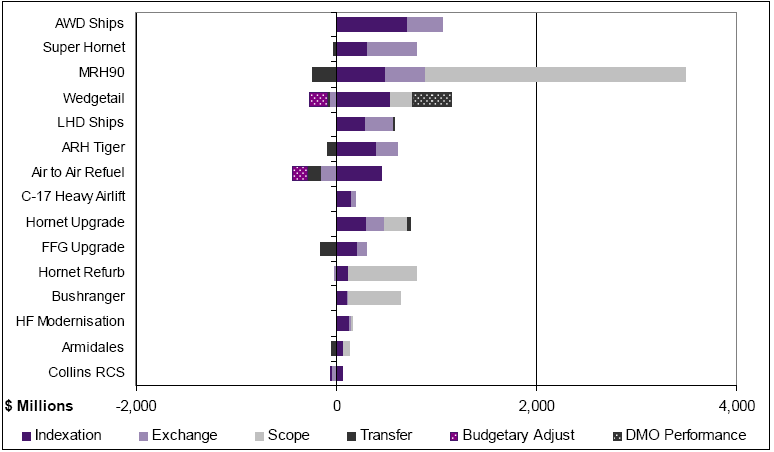
3.5 Figure 3.3 presents a summary of the project budget variations to date i.e. Price Indexation; Foreign Exchange; and Real variations. Significant real variations fall within three main groupings:
• Scope changes: Projects with the largest DMO budget real variation from scope changes approved by Government are:
- MRH90 increased from 12 to 46 aircraft to replace Army's Blackhawk and Navy's Sea King helicopters.
- Wedgetail increased from four to six aircraft.
- Hornet Upgrade scope increased to include an upgrade to the aircraft's electronic warfare self protection suite.
- Hornet Structural Refurbishment scope increased to undertake additional discrete structural modifications on 42 F/A18 Hornet aircraft to address emergent ageing aircraft issues and extend their fatigue life until replaced by the F-35 Joint Strike Fighter.
- Project Bushranger vehicles have increased from an initial 370 to 737 to equip the Enhanced Land Force and acquire vehicles for the Overlander project. The project has also introduced modifications to vehicles from operational experience to provide additional protection to personnel.
- Armidale Patrol Boat numbers increased from 12 to 14.
• Transfers: The next significant category of real variations relates to transfers that occur when a portion of the project scope and budget is transferred to another project or sustainment, or to a Defence Group to perform an element of project scope. For example, significant transfers of the DMO budget were made from the MRH90 and Air to Air Refuelling projects to the Defence Support Group (DSG) to fund the acquisition of facilities.
• DMO Performance: The Wedgetail project had to seek additional supplementation through a real cost increase for contract price indexation variations beyond the supplementation provided by Government. Of the $388m increase, $240m had been consumed for price escalation experienced up to the date of the increase and a further $148m price escalation forecast for the remainder of the project. This increase enabled the project to reconstitute its budget to complete the work remaining on the project and provide for contingency required to manage residual risks. Notwithstanding that this is a price indexation variation beyond the control of the DMO, the only category in the DMO's records under which this can be shown is 'DMO Performance'.
3.6 Price indexation caused by escalation and foreign exchange variations account for the most significant changes to projects' approved DMO budget at Second Pass. These variations are inevitable in complex and long term projects. The next major cause for price variations is represented by 'real variations' which are mainly attributable to capability decisions. For some of the 15 projects, these decisions have resulted in variations to equipment quantities approved by Government. Transfer of funds from the DMO Budget at Second Pass to other Groups in Defence, in the main to the DSG for the acquisition of project related facilities, is the next major cause for budget variations.
3.7 As Table 3.2 shows, after accounting for price indexation, foreign exchange adjustments, Government approved changes to scope and budget transfers, the net variation to overall project cost is $49m. However acknowledging that the $388m increase attributed to the Wedgetail project was due to price escalation, the total net variation in table 3.2 would be a $340m reduction across the 15 DMO MPR projects. Consequently, if the impact from these four factors is removed from the variances in Figure 3.3, very little variance from the Second Pass budget approval exists.
Figure 3.3 - Variance Attribution from Second Pass Budget Approval