Schedule Performance to IOC and FOC
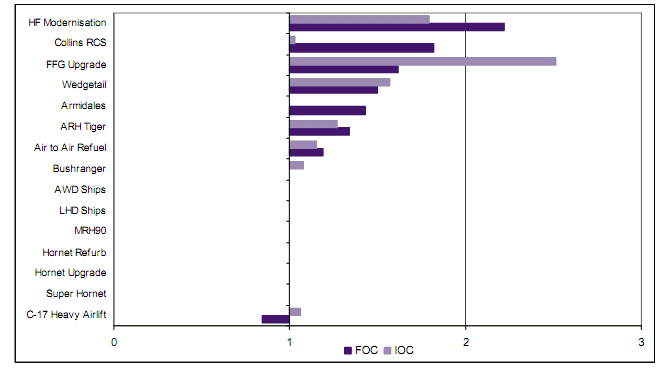
3.8 Figure 3.4 depicts the schedule performance of each project in terms of forecast variance of IOC and FOC from original plan by way of a variance factor. The schedule variance factor is a ratio of the period between achieved or forecast IOC and FOC from Second Pass Approval to the originally planned period between these events. Schedule variance factors:
• of less than one mean the project has come in or is forecast to be ahead of the original planned schedule;
• of one mean the project has come in or is forecast to achieve the original planned schedule; and
• of greater than one mean the project has come in or is forecast to be behind the original planned schedule.
3.9 The average performance across the 15 projects is a variance factor of 1.28, or 28% schedule overrun, for FOC (1.25 for IOC). This reflects very favourably in comparison with international benchmarks. The Standish Group, an international project management and software projects benchmarking organisation, reports that in 2004 the average time overrun in IT projects was 84%;52 the UK Ministry of Defence, Defence Equipment and Support organisation, reported in 2008 a 36%53 overrun across 20 of its major projects.
3.10 It should be noted that the Bushranger project suffered a delay of 26 months in achieving FOC for the first of the three vehicle Production Periods when it experienced a number of technical problems. However, the third Production Period is forecast to be on time.
Figure 3.4 - Schedule Variance Factors
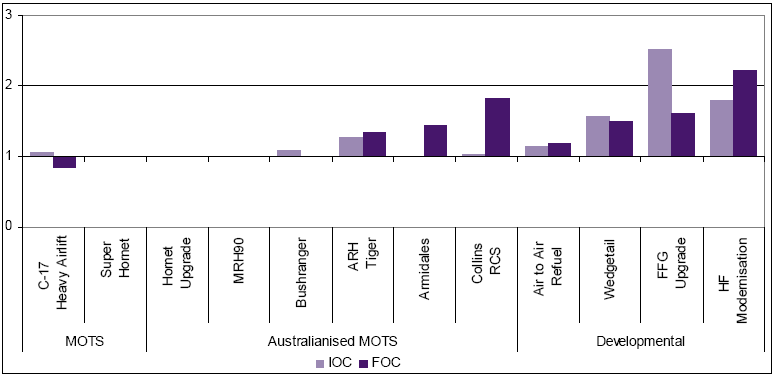
3.11 Figure 3.5 presents the IOC and FOC schedule slippage grouped by project types. Discounting the slippage to the Collins RCS project (where delays primarily result from limited platform availability) the data indicates developmental projects suffer the highest incidence of schedule slippage followed closely by projects requiring Australianisation of off-the-shelf equipment. Schedule risks in these types of projects naturally first impact on IOC when systems are being integrated and tested for the first time in readiness for operational release. The impact of IOC delays is not always equally translated to delayed FOC achievement. This is because delays impacting IOC are not necessarily on the critical path to achieve FOC.
3.12 Developmental projects on both new and existing capabilities are most susceptible to delays. Upgrades to existing capabilities, such as the FFG Upgrade project, pose unique problems associated with refit and life of type extension work being undertaken in conjunction with capability upgrade work. Developmental projects which also have a high dependence on the availability of platforms already in service, such as the mobile platform components of the HF Modernisation project and the Collins RCS project, have a higher potential for schedule slippage.
3.13 True off-the-shelf projects such as the C-17 Heavy Airlift and Super Hornet projects, where virtually no changes are made to proven military equipment and the equipment is available from an existing production line, present the least technical and schedule risk.
3.14 In terms of risk, Australianisation of off-the-shelf equipment projects sits between developmental and off-the-shelf projects. Although initial assessments of such modifications may appear to present relatively low risk, experience has shown that they can introduce unforeseen complexities and risks of a magnitude that can edge a project toward becoming developmental with the attendant risks this entails. In the ARH Tiger project for example, it was never envisaged that the ADF would be the lead customer. However, slippages in the Franco German program caused the ADF to become the lead for acceptance of engineering certification for a period of time and shifted the character of the project from Australianised MOTS to a first of type equipment acquisition. The Lessons Learned section of this report elaborates on this aspect.
Figure 3.5 - Schedule Variance Factors by Project Type
3.15 Schedule performance is by far the biggest issue that the DMO faces in delivering projects to the ADF and this has been publicly acknowledged by the CEO DMO, Dr Gumley. Schedule delays to projects have a number of effects: increasing the overall cost of project delivery; tying up industry and DMO resources for longer than planned, which causes a direct increase in project cost and impedes the transfer of resources to other priority projects; and affecting cash flow because late delivery of goods will also delay payment. The DMO has successfully contained the cost impact of schedule delays through the use of fixed price contracts as well as seeking compensation through the imposition of liquidated damages.
3.16 With reference to Figure 3.5, off-the shelf equipments (ie with virtually no design changes and where the DMO can access existing production lines) represent the least schedule risk. These projects usually deliver within or ahead of planned schedules for delivery.
3.17 On this basis, procurement of OTS equipment emerges as the best option to minimise schedule risk; however minimisation of schedule risk is not the only factor to consider. To ensure the ADF has the best available technology to suit unique Australian requirements and offer interoperability with existing equipment, OTS equipment will not always meet Defence's needs. Despite the higher technical and schedule risk of developmental projects, these factors may justify either development of unique equipment solutions or modification of existing solutions. While the DMO's schedule performance in these projects is comparable to or better than international benchmarks this is not a reason for complacency. Understanding the inherent risks in these developmental projects, adopting risk reduction and risk management techniques and regularly monitoring these risks throughout the requirements development and materiel lifecycle is essential. The DMO, in supporting project approval submissions, minimises risk by ensuring the proposal is mature, the risks are clearly stated and understood, and robust risk management measures are in place.
3.18 In addition to the two-pass Government approval process, the DMO's Gate Review Assurance Board process now comprehensively examines projects at critical milestones or gates in the pre and post government approval phases of a project to ensure that the DMO has the best information available for Government to make an informed decision. Despite best planning and risk management, occasions will arise when projects will be faced with significant issues that were not forecast. The Projects of Concern unit in the DMO monitors projects that encounter these situations, devises strategies to address them, examines and reports on performance remediation and keeps Government advised throughout the process.
_______________________________________________________________________________
52 My Life is Failure: The Standish Group International 2006 - based on CHAOS chronicles Version 5.0.7
53 National Audit Office, Major Projects Report 2008.