Off-The-Shelf Equipment
3.33 Lessons: Military off-the-shelf (MOTS) or commercial off-the-shelf (COTS) equipment is equipment that has been proven in service and in the inventory of a military or commercial organisation. The lessons identified by projects in the DMO MPR in relation to off-the-shelf equipment are best understood as two distinct issues: accelerated procurement of true MOTS equipment, e.g. C-17 Heavy Airlifter and Super Hornet projects, where complexities in establishing in-service support systems have been encountered; and modified MOTS/COTS equipment such as the Air to Air Refuelling and Armed Reconnaissance Helicopter projects in which the design maturity of MOTS was underestimated.
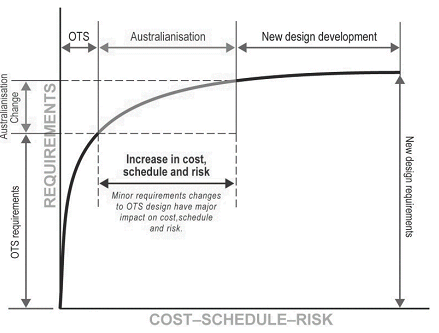
3.34 Implementation: An important part of the two-pass Government approval process is consideration of off-the-shelf options to satisfy capability needs or an explanation of why such an option is not available. Any option that proposes Australianisation of OTS equipment must detail the rationale, and associated costs and risks. As some of the lessons recorded by DMO MPR projects show, the extent of Australianisation of an off-the-shelf equipment solution can introduce significant project risk. Figure 3.9 below illustrates the disproportionate impact that seemingly small changes to off-the-shelf equipment can have on cost, schedule and risk.
Figure 3.9 - Concept Diagram; impact on cost, schedule and risk of volume of requirements
3.35 C-17 Heavy Airlifter and Super Hornet projects were acquired with virtually no change to their base design. Because the DMO procured aircraft from an existing production line, deliveries were achieved on time. However, due to the complexity of the necessary support and support infrastructure requirements, the projects experienced difficulties in synchronising development of support capability with aircraft deliveries despite the ability to leverage off mature US Air Force and US Navy support arrangements such as spares, repairable items and engineering and maintenance support. In response, the DMO is strengthening its guidance for the development of support concepts and support strategies at the time of capability development. This early work must emphasise comprehensive understanding of the complexity of support systems for OTS equipment.
3.36 In the case of the Air to Air Refuel and ARH Tiger projects, their design maturity was overestimated during the tender evaluation and pre-contract phases. The introduction of more in-depth risk reduction effort through offer definition processes, ahead of project approval and contract signature, is intended to assist in the early identification of such risks.
3.37 Where the DMO is acquiring equipment which is also under procurement by a foreign Government, slippages in the procurement schedule of the latter can put the DMO in the position of being a lead customer bearing an unplanned and significant proportion of risk. In the case of aircraft, airworthiness certification becomes a significant issue particularly when the ADF had planned to rely on the certification process of another military but later found itself to be the lead customer.
3.38 The DMO has been progressively updating its standard technical review processes to promote the early identification and management of developmental and integration risks through the acquisition phase of the materiel system lifecycle.