Introduction
2.1 Key project performance information is important in monitoring whether the required capability is expected to be delivered on schedule and within budget. Such information has the potential to act as an alaert to under-performance and a focus for management action.
2.2 Four key measures on the status of each project have been derived from data in the PDSSs to provide snapshots on project performance.
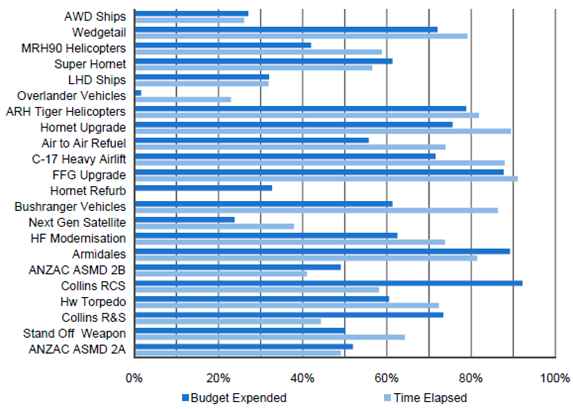
2.3 Figure 2 sets out two of these measures: percentage of budgeted cost expended and percentage of the scheduled time elapsed. The figure shows that, for most projects, the budgeted cost expended is broadly in line with the proportion of time that has elapsed in projects' schedules.37 38 The main exceptions include the two Collins Class Submarine projects (replacement combat system, and reliability and sustainability enhancements), where most of the materiel has been acquired and expenditure undertaken, but difficulties in obtaining a sufficient amount of time in the submarines' full cycle docking program to install the equipment has pushed out each project's schedule. In other cases, issues related to contractor delivery against the contract (Air to Air Refuel) and delays in entering into the contract (Overlander Vehicles - Medium/Heavy Capability) have impacted on the extent of budgeted cost expended relative to the current point in their planned schedule.
Figure 2
Project Snapshot - Budget Expended and Time Elapsed (percentage)
Source: 2009-10 MPR and ANAO analysis.
Note 1: The budget expended data for this figure is the percentage of the approved budget costs expended, as at 30 June 2010. The schedule time elapsed data is the percentage of months elapsed from the original project approval date to the forecast final operational capability date, as at 30 June 2010.
Note 2: The Hornet Refurb project does not have an FOC date as it does not introduce new capability to the Hornet aircraft fleet.
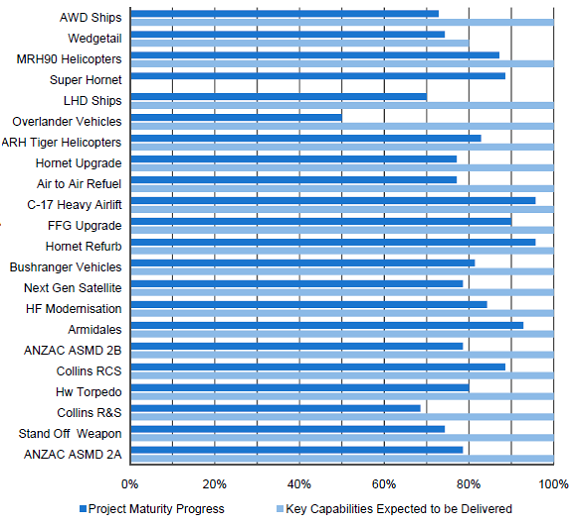
2.4 The second snapshot, Figure 3, sets out each project's current maturity score and the DMO's assessment of the likelihood of delivering all the key capability requirements it has agreed to deliver.39 40 The DMO's assessment is informed by the range of risks and issues that the project has identified and is addressing. Whether a project is primarily developmental in nature (such as the Wedgetail project), or a military-off-the-shelf solution (such as the Super Hornets or C-17 Heavy Airlift aircraft), has been shown to be a significant factor affecting the likelihood of delivering all the key capabilities; with the risk appreciably higher for more developmental projects. The DMO's assessment of the likelihood of any project delivering all the key capability requirements should become better informed as a project's maturity score increases.
2.5 While the DMO's key capability measures should be interpreted with some caution due to their lack of rigour as a data system and the high level of uncertainty in forecasting outcomes,41 overall, the DMO's assessment is that 20 of the 21 projects with key capability data in this year's MPR will deliver all their key capability requirements. The project of note that is not expected to deliver all its key capability requirements is Wedgetail, where the system's radar performance is not expected to meet the required current specification at final delivery.
Figure 3
Project Snapshot - Project Maturity Progress and Key Capabilities expected by DMO to be delivered (percentage)
Source: 2009-10 MPR and ANAO analysis.
Note: The DMO has advised that the Super Hornet project does not have endorsed key capability measures (Measures of Effectiveness).
________________________________________________________________________
37 Projects' budgeted cost and schedule data is the position as at 30 June 2010, and may differ from originally approved budgets and schedules.
38 Projects' budgeted cost expended is accrual based. In cases where pre-payments/committed funds have been made but have not been expensed/amortised (for example, the Super Hornet, AWD Ships, LHD Ships and C-17 Heavy Airlift projects), cash paid by a project will be greater than the percentage of budget expended as shown in Figure 2.
39 The project maturity score quantifies the maturity of a project by way of a score, based on the project managers' judgement at defined milestones in the capability development and acquisition phases. This score can then be compared against an ideal or benchmark score for that milestone to indicate the project's relative performance.
40 As the DMO's assessment of the likelihood of delivering key capabilities involves high levels of uncertainty which may cause actual outcomes to differ materially from that stated in the PDSSs, this data and the DMO's assessment is outside the scope of the ANAO's assurance review for the 2009-10 MPR.
41 ANAO's examination of the DMO's key capability measures is set out at paragraphs 2.24 and 2.25.