Life to date schedule performance
2.15 The DMO has acknowledged that performance against the schedule is the biggest issue that the organisation faces in delivering projects to the ADF.45 Schedule delays increase the overall cost of project delivery as both DMO and industry staffing and administrative resources are tied up for longer than planned. For Australia's front line forces, timely access to new and upgraded capabilities is delayed.
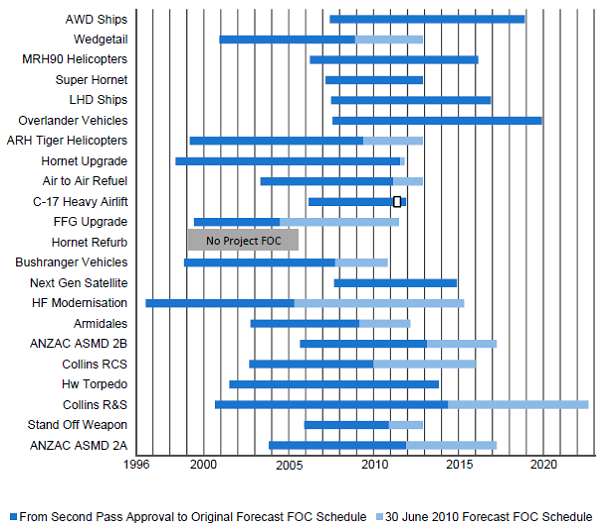
2.16 Figure 8 presents information on the projects' original and 30 June 2010 forecast for achieving FOC. The total delay for the Major Projects is expected to be 688 months as compared to the prediction when first approved. This slippage represents a 31 per cent increase on the expected schedule since the main investment decision.46 Across the Major Projects, 13 projects have experienced a slippage in expected FOC achievement. However, one project, the C-17 Heavy Airlift, which is a military-off-the-shelf acquisition, is forecast to achieve FOC 11 months ahead of its original schedule.
Figure 8
Projects' Original and 30 June 2010 Forecast Schedule for FOC
Source: 2009-10 MPR.
Note 1: Hornet Upgrade FOC date relates to Phase 2.3.
Note 2: Bushranger Vehicles FOC date relates to production period 1. The FOC date for production period 3 is April 2012.
Note 3: HF Modernisation FOC date relates to the upgrade of mobile platforms.
Note 4:  indicates C-17 Heavy Airlift is forecast to achieve FOC 11 months earlier than original schedule.
2.17 Assuming soundly-based schedule forecasts, the reasons for schedule slippages can include technical factors such as design problems, difficulties in integrating different systems to achieve the required capability, or emergent work associated with upgrades. In other cases, a project's ability to gain access to the platform can impact on the schedule (for example, the two Collins submarine projects covered in the 2009-10 MPR).
_____________________________________________________________________
45 Australian National Audit Office, 2008-09 Major Projects Report, Part 2, p.119.
46 In the instances where a Major Project has multiple segments/capabilities with separate FOC dates, the ANAO has used the project's current lead/main capability FOC for calculating schedule performance. The DMO's approach is to use the final FOC date for a project listed in the 2009-10 PDSSs. These two valid approaches lead to a small difference in the calculated percentage by which the Major Projects' total schedule has slipped for the 2009-10 MPR (ANAO - 31 per cent; and DMO - 30 per cent).