DMO Overview
1.6 An overview of DMO's business is presented in the following figures and tables.
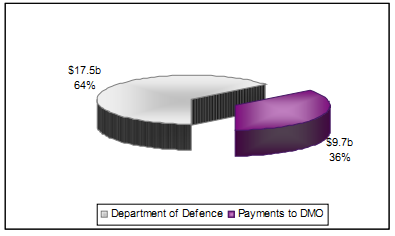
1.7 Figure 1.1 shows that the total budget for the Department of Defence in 2009-10 was $27.2b. Of this, $9.7b80 was budgeted for planned payments to the DMO under Purchaser Provider Arrangements to support the DMO's acquisition and sustainment activities. The figure demonstrates the significant investment made in DMO support to capability for the ADF, and when assessing the DMO budget as a whole ($10.7b in 2009-10), equates to 0.9% of Australia's Gross Domestic Product (GDP) in 2009-1081.
Figure 1.1 - Payments to DMO as a Proportion of the Department of Defence Budget 2009-1082
1.8 The Capability, defined as 'the power to achieve a desired operational effect in a nominated environment, within a specified time, and to sustain that effect for a designated period'83,is generated by Fundamental Inputs to Capability (FIC) comprising:
● organisation;
● personnel;
● collective training;
● major systems;
● supplies;
● facilities;
● support;
● command; and
● management.
1.9 The DMO is primarily responsible for managing the procurement of the materiel system component of the capability, comprising mission systems, designated elements of training and non-infrastructure equipment for facilities that support the operation of ADF equipment, such as simulators, trainers and complex test equipment. To achieve all inputs to capability, Defence and the DMO adopt a collaborative approach.
1.10 Capability systems have a life cycle that begins with the identification of a need, moving through to identifying the requirements, then to the acquisition of the capability, operating and sustaining it in-service, and then the final disposal phase when the equipment is no longer required.
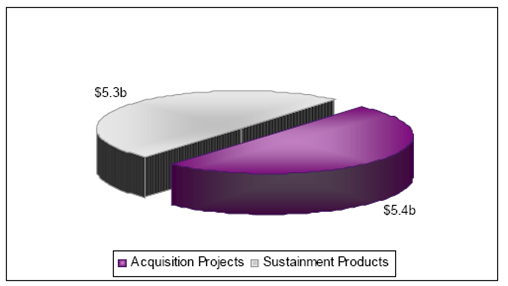
1.11 In addition to acquisition projects, the DMO also managed 108 sustainment products during the financial year. As figure 1.2 demonstrates, the 2009-10 budget allocation between acquisition and sustainment is relatively evenly distributed, but this may change over time. This demonstrates the strategic significance of sustainment activities and the ongoing effort required to maintain the necessary level of operational capability. The size of the sustainment budget also reflects the technically challenging nature of sustainment activities.
Figure 1.2 - Budget Allocation to Acquisition Projects and Sustainment Products 2009-10
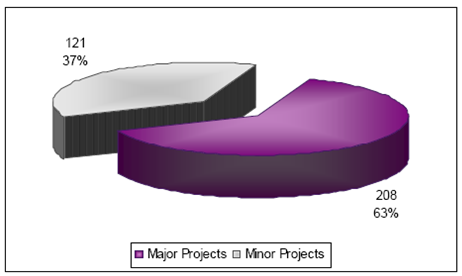
1.12 Approximately two thirds of acquisition projects undertaken in the DMO are considered 'Major Projects' with the remainder classified as 'Minor Projects' (see figure 1.3 below). Major capital equipment projects are funded through the Defence Capability Plan (DCP) and generally have a budget allocation of more than $20m. Projects of lesser value may also be funded through the DCP if they are particularly complex or of strategic significance.
Figure 1.3 - Number of Major and Minor Acquisition Projects 2009-10
1.13 A Minor Capital Acquisition Project is funded through a Defence Group budget allocation under the Minor Capital Acquisition Program (generally a Service Group - Navy, Army, or Air Force). In budgetary terms, minor projects, although generally costing less than $20m, are not necessarily of low significance from a capability perspective as they can include essential equipment to sustain and protect our troops.
1.14 The 22 major DMO projects covered by this MPR are shown in table 1.1.
Table 1.1 - List of 2009-10 MPR Projects by Total Approved Budget84 85
Project Name | Project Number | 2009-10 | Total Approved Project Budget $m |
Air Warfare Destroyer | SEA 4000 Phase 3 | $977.1 | $7,740.1 |
Airborne Early Warning & Control Aircraft | AIR 5077 Phase 3 | $330.4 | $3,883.5 |
Multi Role Helicopter | AIR 9000 Phase 2, 4 & 6 | $475.4 | $3,754.6 |
Bridging Air Combat Capability | AIR 5349 Phase 1 | $965.2 | $3,629.1 |
Amphibious Deployment and Sustainment | JP 2048 Phase 4A & 4B | $677.6 | $3,160.8 |
Overlander | LAND 121 Phase 3 | $34.0 | $2,879.2 |
Armed Reconnaissance Helicopter | AIR 87 Phase 2 | $262.1 | $2,076.3 |
F/A-18 Hornet Upgrade | AIR 5376 Phase 2 | $130.8 | $1,946.6 |
Air to Air Refuelling | AIR 5402 | $194.7 | $1,889.4 |
C-17 Globemaster III Heavy Airlifter | AIR 8000 Phase 3 | $8.1 | $1,834.6 |
Guided Missile Frigate Upgrade | SEA 1390 Phase 2.1 | $46.6 | $1,529.6 |
F/A-18 Hornet Structural Refurbishment | AIR 5376 Phase 3.2 | $55.9 | $943.5 |
Bushmaster Protected Mobility Vehicle | LAND 116 Phase 3 | $102.3 | $926.2 |
Next Generation SATCOM Capability | JP 2008 Phase 4 | $103.4 | $894.1 |
81High Frequency Modernisation | JP 2043 Phase 3A | $38.9 | $662.7 |
Armidale Class Patrol Boat | SEA 1444 Phase 1 | $13.0 | $536.7 |
ANZAC Anti Ship Missile Defence | SEA 1448 Phase 2B | $86.0 | $458.5 |
Collins Replacement Combat System | SEA 1439 Phase 4A | $12.2 | $458.0 |
Replacement Heavyweight Torpedo | SEA 1429 Phase 2 | $21.7 | $441.5 |
Collins Class Reliability and Sustainability | SEA 1439 Phase 3 | $26.0 | $407.7 |
Follow-on Stand Off Weapon | AIR 5418 Phase 1 | $34.7 | $399.6 |
ANZAC Anti Ship Missile Defence | SEA 1448 Phase 2A | $39.5 | $377.1 |
| Total | $4,635.6 | $40,829.4 |
_________________________________________________________________
80 Portfolio Additional Estimates Statements 2009-10, Defence Portfolio.
81 Based on 2.0% GDP growth figures disclosed in the Treasurer's budget speech 2009-10.
82 The DMO has three funding sources: Government (Appropriation Revenue), Defence (Goods and Services) and Other Revenue. Prior to 2009-10 the DMO received a 'service fee' from Defence, but under the Mortimer Review Reforms the service fee is now referred to as Workforce and Operating Costs and from 1 July 2009 is a direct appropriation from Government. In addition to the income received from Defence in Figure 1.1, in 2009-10 the DMO received a direct appropriation from Government of $899m for ordinary annual services.
83 Interim Defence Capability Development Manual
84 The convention used in this report is to list projects in order of their total approved budget, from highest to lowest. Where the analysis requires a different order, an explanation is provided.
85 For the 2010-11 MPR Program, the AIR 6000 Phase 2A/B New Air Combat Capability (Joint Strike Fighter) project will be included as a 'New Project'. This project was not included in the 2009-10 MPR Program as it did not meet the JCPAA criteria for inclusion, as set out in the JCPAA Report 416 - Review of the Major Projects Report 2007-08, November 2009, p.18.