Project Complexity
1.17 The DMO cannot provide Defence with the cutting edge technologies needed to maintain the capability advantage if it does not accept risk. Risk is intrinsic in the delivery of the many highly technical projects that often require development of technologically advanced systems or modification of existing weapons systems to meet Australia's needs. Good governance then requires that the DMO, to the best of its capability, manages those risks and takes timely action to address risks emerging during projects.
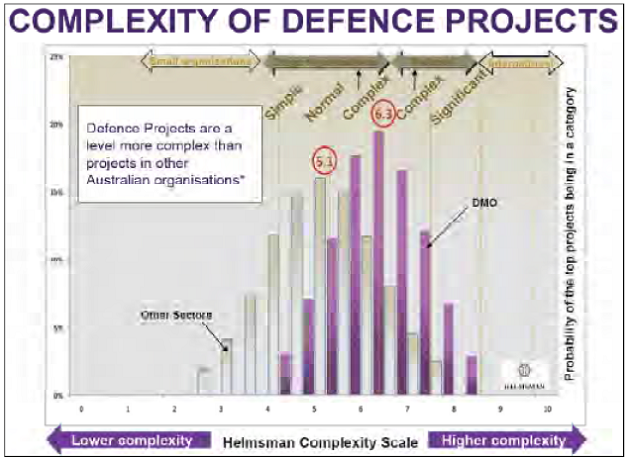
1.18 The Helmsman Institute in 2009 undertook analysis on behalf of the DMO that looked at the complexity involved with Defence and DMO projects as compared to those undertaken in general industry. The results are shown in figure 1.4.
1.19 As this figure demonstrates, the Defence-DMO projects are more complex than projects managed by other Australian Organisations. To give the ADF the edge it needs the DMO will continue to acquire and manage complex projects but also work with industry to better identify and manage the inherent risks with these projects.
Figure 1.4 - Analysis of DMO Project Complexity Versus Industry
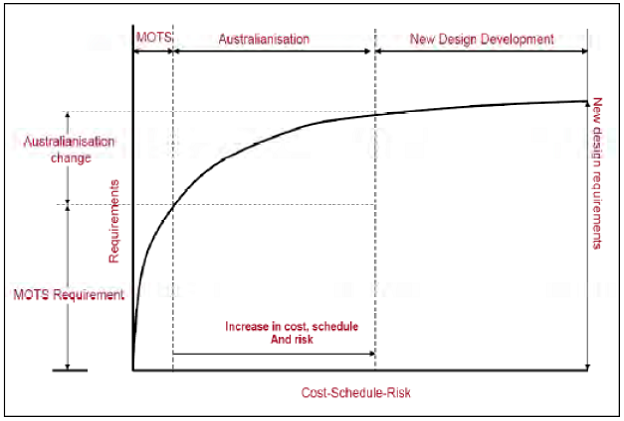
1.20 There are three main types of acquisition undertaken by the DMO. Military-Off-The-Shelf (MOTS) acquisitions are for hardware or software that already exists, is in-service with one or more other customers for an equivalent purpose and requires no, or minimal, change. Australianised MOTS is where the product is modified to meet particular Australian requirements. Developmental are those projects where the product does not currently exist Off-The-Shelf and such an option might be delivered through: developing a new product; integrating existing Off-The Shelf components to deliver a new product; or the participation in another nation's development program. Cost- schedule-risk parameters increase as the extent of Australianisation or development work required increases.
1.21 The Defence White Paper 2009 identifies that Military-Off-The-Shelf and Commercial-Off-The-Shelf solutions to defence capability requirements will be the benchmark against which a rigorous cost-benefit analysis of the military effects and schedule aspects of all proposals will be undertaken. This is consistent with the Defence Procurement and Sustainment Review (Mortimer Review). The key consideration is balancing the need to meet unique or specific capability requirements against the likely increase in project risk.
1.22 Requirements that go beyond that of Off-The-Shelf equipment generate disproportionately large increases to the cost, schedule and technical risk of projects. Off-The-Shelf products generally enjoy relatively large production runs with mature quality assurance processes. This enables industry to spread the cost of development and set up costs across a wide product base. By contrast, developmental projects usually involve small production runs. Unlike those products that have been in use and therefore have proven performance, developmental projects involve a high degree of risk to cost and schedule to achieve the required level of capability. The impact on cost and schedule of small changes can be illustrated by Figure 1.5.
Figure 1.5 - Increased Technical Development over Cost-Schedule-Risk Profile
1.23 Given Australia's unique defence position, Off-The-Shelf solutions are not always practical, however, and at the very least, minor changes will almost certainly be necessary to ensure interoperability with other ADF assets and systems. In addition, changes to an Off-The-Shelf option are sometimes necessary to ensure compliance with ADF or broader Australian technical regulations. Modifications necessary to achieve specified capability or compliance can inject significant additional risk and cost into projects.
1.24 In the case of upgrading an existing platform, an off-the-shelf solution is sometimes impossible because no such upgrade package may exist. While the cost and risk of such an upgrade can be reduced by using Off-The-Shelf components, the integration of disparate sub-systems has often proven to be a high-risk exercise.