Schedule Performance
2.21 Figure 2.4 shows the project schedule for the life of each of the major projects within this year's MPR. The project schedule commences from original project approval date (i.e. second pass Government approval or equivalent) through to original planned FOC for the totality of the project, and where slippage/gain has occurred, to the forecast FOC as at 30 June 2010.
2.22 As figure 2.4 indicates, the DMO major projects are at various stages of maturity and have differing elapsed times depending on the start date, scope and complexity of each project. C-17 Heavy Airlift is scheduled for completion (FOC) in the 2010-11 financial year with Armidales, FFG Upgrade, Hornet Upgrade and Bushranger Vehicles expected to be finalised during 2011-12. These projects will be considered for removal from the MPR for 2011-12. There is a cluster of acquisition projects scheduled to be finalised during 2012-13, which will result in these projects shifting into the sustainment phase of the capability life cycle at that time.
2.23 The seven projects with the most significant schedule variation (those with a schedule slippage of 50% or greater) are detailed below:
● FFG Upgrade - The technical complexity of the large scale integration and platform modification resulted in schedule delays to meet a major improvement to capability;
● HF Modernisation - Contractor underestimation of complexity and effort required in delivering the final system has caused schedule slippage. However, it should be noted that the core system was accepted in October 2004. Since April 2009, the contractor has achieved progress ahead of the revised schedule and has met the remaining contractual milestones;
● Collins R&S and Collins RCS - Schedule delays are primarily related to platform unavailability due to operational requirements and changes to the submarine Full Cycle Docking (FCD) schedule (a result of unscheduled maintenance arisings), control of which rests outside the DMO;
● ANZAC ASMD 2A and 2B - Schedule slippage has been primarily driven by the Government approved scope change to acquire a 'phased array radar' based solution (which offered a significant capability advantage) over the 'Very Short Range Air Defence System' originally selected; and
● Wedgetail - Schedule delays are primarily driven by contractor underestimation of the technical challenges associated with integration of the phased array radar into an operational system (which has never been previously undertaken). The contractor also underestimated the complexity of integrating other mission critical systems.
Figure 2.4 - Schedule Second Pass to Current FOC Estimate

2.24 Both table 2.4 and figure 2.5 depict schedule performance of each project in terms of forecast variance of FOC from original plan by way of a variance factor. The schedule variance factor is a ratio of the period between achieved or forecast FOC at Second Pass Approval to the originally planned period between these events. Schedule variance factors:
● of less than one means the project delivered or is forecast to deliver ahead of the original planned schedule;
● of one means the project has delivered or is forecast to achieve the original planned schedule; and
● of greater than one means the project has delivered or is forecast to be behind the original planned schedule.
2.25 Twelve of the 21109 projects in the MPR show a schedule slippage between original and current FOC estimates, whilst eight are tracking on schedule and one project (C-17 Heavy Airlift) has achieved ahead of schedule, with FOC expected to be almost a year earlier than originally planned. It is pleasing to note that the HF Modernisation project was able to regain some of the schedule slippage encountered in previous years. Overall in 2009-10, the average schedule performance factor for all projects is 30% slippage (variance factor 1.30), which comprises the 29.5% (variance factor 1.295) across the 14 'Repeat Projects', and 31.5% (variance factor 1.315) across the seven 'New Projects'110. The schedule slippage reported in the 2008-09 MPR, based on the 14 project sample, was 28% (variance factor 1.28).
2.26 Detailed information regarding the cause and extent of slippage for each project is contained within the PDSS in Part 3. However, a synopsis outlining causes for schedule delays is provided in table 2.4.
Table 2.4 - Schedule Slippage Attribution
| Driver of Schedule Slippage | Project | Schedule Variance Factor |
| Platform unavailability due to operational Requirements | Collins RCS | 1.73 |
| Collins R&S | 1.60 | |
| Underestimation by Industry and/or Defence of the complexity of these highly developmental and large scale integration projects
| Wedgetail | 1.50 |
| ARH Tiger Helicopters | 1.34 | |
| Air to Air Refuelling | 1.22 | |
| FFG Upgrade | 1.86 | |
| ANZAC ASMD 2B | 1.54 | |
| ANZAC ASMD 2A | 1.66 | |
| HF Modernisation | 2.14 | |
| Stand Off Weapon | 1.40 | |
| Hornet Upgrade | 1.02 | |
| Need to fix latent defects | Armidales | 1.47 |
2.27 The previously mentioned linkage between the three main types of acquisition (MOTS, Australianised MOTS and Developmental) is reinforced in figure 2.5, ie. the higher the degree of modification and development, the higher the risk associated with the project. Detailed information regarding the cause and extent of slippage for each project is contained within the PDSSs in Part 3. However, it is important to note that irrespective of whether a project reports a slippage in scheduled FOC date, in many cases significant capability has already been delivered and is in use by the ADF. The Armidale Class Patrol Boat project is an example where, although FOC has yet to be achieved, capability has been used effectively in protecting our northern waters, while a rectification program continues to address remaining latent defects.
Figure 2.5 - Schedule Variation Factors from Second Pass Approval (by project type)
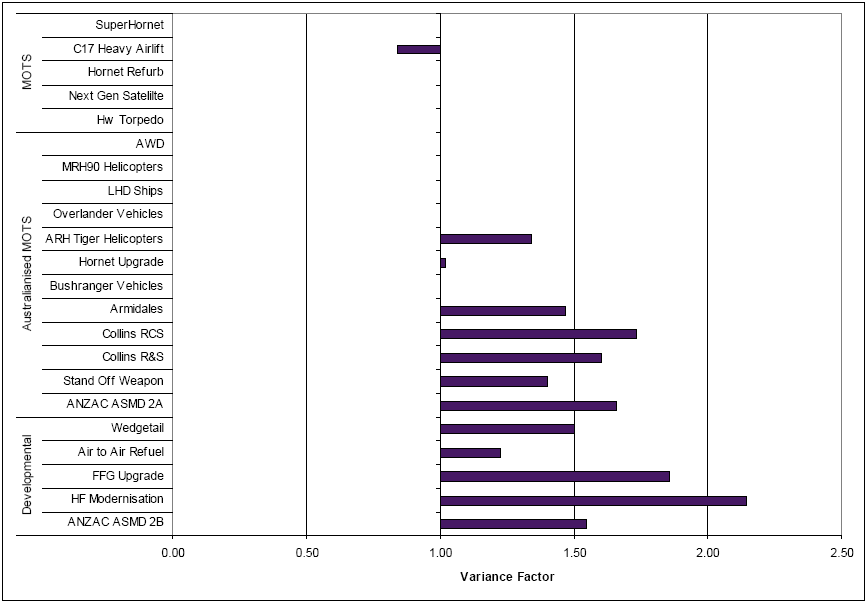
2.28 Figure 2.5 also illustrates those projects with nil variance, those with schedule gain and those incurring schedule slippage.
● Nil Variance - Nine projects show no variation to schedule. These are either less complex acquisition arrangements (i.e. MOTS) and/or projects in the early stages of the project life cycle.
● Schedule Gain - C-17 Heavy Airlift is ahead of schedule by almost one year. This positive outcome is due primarily to the nature of the project (i.e. rapid acquisition and MOTS). The strong performance of all MOTS projects against schedule is consistent with the lower risk and complexity associated with these projects.
● Schedule Slippage - All developmental projects and over half of the Australianised MOTS projects have incurred slippage to the schedule approved at Second Pass. By contrast, none of the five MOTS projects has experienced schedule slippage. This slippage is attributable to the higher levels of complexity and risk for these developmental and Australianised MOTS projects. As this report has shown, the higher the technical challenge, the higher the inherent risk to schedule. Developmental projects are new and often at the leading edge of available technology. As such, it is not uncommon for projects to encounter unforeseen technical difficulties requiring significant modification, thereby having a negative impact on schedule. Similarly, Australianisation can also encounter unforeseen technical difficulties and have an unanticipated impact on existing features of the baseline MOTS product. The rectification of such issues often requires extensive, time consuming remediation work.
_______________________________________________________________________
109 Hornet Refurb project does not have a FOC and is therefore not included in the FOC analysis.
110 For this analysis, the DMO notes the ANAO has calculated a schedule slippage of 31% against DMO's 30%. The data used by both agencies is correct, but ANAO has chosen to use the 'Lead/Main' FOC date for schedule calculation, whereas the DMO uses the final FOC date.