Capability Performance
2.29 Measures of Effectiveness (MOE) are tied directly to the capability to be delivered by the project and represent the key capability performance attributes of a project, which if not satisfied would have a significant effect on the eventual suitability for operational service. The MOEs for each project are identified in the project approval documentation that details the capital equipment assets to be delivered, including the Operational Concept Document and the Function and Performance Specification.
2.30 The DMO MPR does not identify the individual MOEs for projects for security classification reasons; however, each PDSS has a percentage breakdown on how the project is tracking against its particular suite of MOEs.
2.31 The traffic lights, based on a subjective assessment, indicate:
● Red: MOEs that at this stage are unlikely to be met;
● Amber: MOEs that are under threat but still considered as manageable and able to be met; and
● Green: MOEs for which there is a high level of confidence that they will be met.
2.32 The number of MOEs that are reported as at 30 June each year alters depending upon the number of MOEs agreed in project documentation. For example, across the original nine projects in the 2007-08 MPR, there were 55 MOEs reported as at 30 June 2008. Two years later, as at 30 June 2010, the same nine projects reported against a total of 67 MOEs. Consequently, this fluctuation in the number of MOEs across years has to be considered when analysing the DMO achievement against the percentage of green, amber and red MOEs111.
Figure 2.6 - Analysis of MOEs for the 9 MPR Projects Covered in the 2007-08 Report (Over the Period 2007-08 to 2009-10)
|
|
|
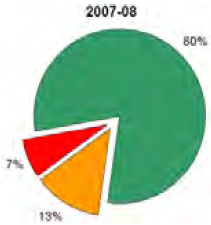
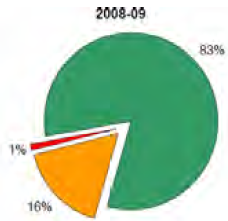
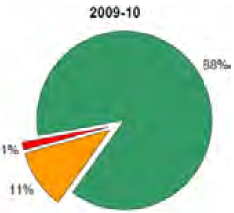
2.33 Figure 2.6 identifies the change in MOE status of the first nine projects covered in the 2007-08 DMO MPR, which is analysed below:
● Green - Across the three years, the percentage of green MOEs continues to increase;
● Amber - The percentage of amber MOE indicators has remained relatively consistent (average of 13% across the three years); and
● Red - Pleasingly, the percentage of red MOEs for these nine projects has reduced from 7% to 1%.
Figure 2.7 - Analysis of MOEs for 14 of the 15 MPR Projects Covered in the 2008-09 Report (Over the Period 2008-09 to 2009-10)
|
|
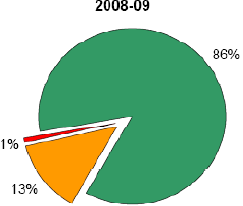
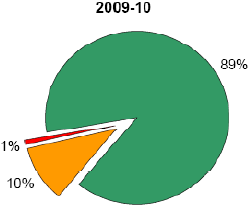
2.34 Figure 2.7 identifies the change in MOE status of the 14 projects covered in the 2008-09 DMO MPR (Super Hornet does not have a defined set of MOEs) and is analysed below:
• Green - A similar trend is shown to the nine MPR projects in the 2007‐ 08 data set, whereby the percentage of green MOEs has increased over the two year period;
● Amber - The decrease in amber MOEs is driven primarily by favourable DMO project management practices that have assisted to address MOEs that were under some threat to a situation where they will now be met; and
● Red - The percentage of red MOEs remains static at 1%. However, the number of MOEs decreased and therefore the retention of the 1% red MOE measurement is again a positive outcome for DMO's project management.
Figure 2.8 - Analysis of MOEs for 21 of the 22 MPR Projects Covered in the 2009-10 Report (Over the Period 2009-10)112
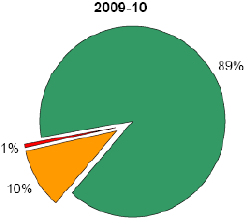
2.35 For the 2009-10 DMO MPR, there are 138 individual capability MOEs across 21 projects (Super Hornet does not have a defined set of MOEs) with a breakdown of 123 green, 14 amber and one red (as shown in figure 2.8). A red or amber MOE indicates the current status of the capability as at 30 June 2010 and is not indicative of the project's ability to deliver the intended scope.
● Green - The trend identified in previous MPRs is also reflected for 2009-10 with a high percentage (89%) of green MOEs reported;
● Amber - The amber MOEs (10%) are reported across six projects. Details include:
- Wedgetail - relates to the projects ability to conduct operations in its intended operational environment;
- MRH90 Helicopters - relates to the achievement of certification, training and support requirements;
- FFG Upgrade - relates to issues with electronic support and defensive systems causing delays to operational release;
- Next Gen Satellite - relates to pressures associated with the installation of support systems and activation of the orbital slot;
- Hw Torpedo - submarine availability due to operational requirements has impacted the project's ability to conduct weapons testing and other operational scenarios; and
• Red - The one red MOE (1%) relates to the Wedgetail project. Although Wedgetail has improved from last year (decrease by one red MOE), some concern still remains over the project's ability to conduct operations in its intended operational environment.
2.36 The delivery of capital equipment assets for the ADF remains the prime focus for the DMO, and senior management continues to apply intensive effort and sponsor business improvements to address any deficiencies in MOE achievements.
___________________________________________________________________________________
111 Comparison of an individual or a group of projects' MOE data across years needs to be treated from the perspective that identification of, and assessment over, MOE data can differ from project to project.
112 For the 2009-10 MPR, non-capability related MOEs (those that report on cost and schedule measures) have been excised to compile the above figure.