Introduction
The PSC is a model of the risk-adjusted costing of the public sector as a supplier of the outputs specified in the output specification. The PSC is comprised of a series of internal benchmarks that specify the main attributes of the entire project on a whole-of-life basis, specifically:
■ the standard of performance required in the delivery of outputs; and
■ an analysis of the cost sensitivities and financial impact of project risks.
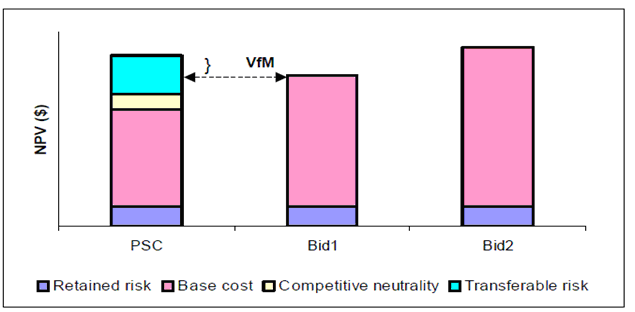
Value for money is demonstrated when the total present value cost of private sector supply is less than the net present value of the base cost of the service, adjusted for:
■ the cost of risks to be retained by the Government
■ competitive neutrality effects; and
■ cost adjustments for transferable risks.
Figure 1 The PSC and value for money
The components of total cost for the PSC and the private supplier are:
■ retained risks which, by their nature, always rest with the public sector. The cost of retained risks is identical for the PSC and the private supplier. Retained risks are typically:
- changes in enabling laws or regulations, and
- demand for the services (where there is no direct charge to the public) for instance long term demographic changes;
■ the base or raw cost of providing the services required by the public sector. This is the public sector's estimate of what it will spend to build, and maintain the infrastructure and provide the associated services over its expected useful life in accordance with the performance specification; and
■ risk adjustments for transferable risks that reflect the probability that services may not be delivered at the cost shown in the base cost projection because of events like cost overruns or technical problems, or that budgets may be maintained, but only at the expense of reductions in service quality.
The PSC should not be confused with an "in house" bid. Indeed, where an agency is bidding in competition with the private sector, the in house bid will be assessed against the PSC on an equivalent basis with private sector bids. Strict principles of probity apply in the case of in-house bids and the in-house bidder must be treated in the same manner as any other bidder.