6.2 Third party access arrangements
On two occasions cooperative third party access arrangements to access infrastructure managed by an existing water utility have been granted in Australia. Where disputes have arisen between new entrants and the incumbent they are dealt with by the third party access provisions of the Trade Practices Act. In the Services Sydney Pty Ltd case this was an involved, costly and time consuming process.
New entrants attempting to gain third party access to existing urban infrastructure can also face problems obtaining accurate information about the value and condition of water supply and sewerage assets, which are largely hidden underground. Another practical impediment to this type of access is the high cost of establishing infrastructure and transmitting water and wastewater services which means that there is often only one supply network in each location (a natural monopoly). As Balance and Taylor (2004 p.14) note this represents a constraint to the establishment of competitive markets. Nevertheless, in some cases the development of infrastructure which is separate to the water supply network and associated with one water source such as a groundwater bore site, a desalination plant or recycling plant provides greater opportunities for new entrants.
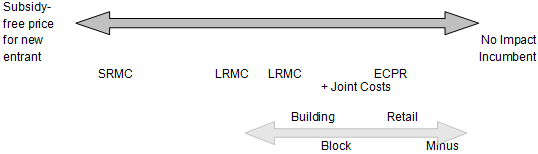
The spectrum of rules that are available to set prices for new entrants seeking a third party access arrangement to water supply and wastewater infrastructure and a description of these terms are provided in Figure 2. The approaches generally favoured by incumbents (building block and retail minus) may not provide the most efficient price signals for consumers - thereby potentially working against new entrants.
Figure 2: Spectrum of rules for setting prices to access monopoly infrastructure
|
Short-Run Marginal Cost (SRMC) represents the short-term increase in costs faced by the incumbent as a result of the additional demand placed on the system by the new entrant. This often represents day-to-day running costs such as increased pumping costs, although may be significantly higher if any augmentation of the infrastructure is required. Long-Run Marginal Cost (LRMC) is the long-term incremental cost associated with the demand from the new entrant, often a period of 20 years or more in utility industries. This includes the acceleration or development of new infrastructure caused by the introduction of the new entrant, in addition to the increase in operating costs. The Building Block approach distributes the cost of the transmission system amongst all users based on usage. The cost includes recovery of capital and operating costs over a fixed time period, including an appropriate return on assets. Building Block charges are relatively straightforward to calculate, less open to manipulation and can ensure full cost recovery for the utility. The primary disadvantage of this method is that it does not provide efficient price signals regarding the change in costs caused by the new entrant. This method is widely used for access pricing in the electricity and gas industries. The Retail Minus method involves determining the wholesale cost of supply by subtracting the cost of retail services from the retail price. This methodology has been applied in the telecommunications sector in the pricing of calls for resale, however it remains most relevant to markets in which the new entrant is providing retail services only rather than both retail and wholesale services. The Efficient Component Pricing Rule (ECPR) methodology determines access charges by adding incremental costs to the existing retail tariff and subtracting the costs that the incumbent would have incurred in providing the same service ("avoided costs"). |
Adapted from Marsden Jacob 2005