Note 1 - The Issue Analysis/Dinner Party approach (IADP™)
3 The Issue Analysis/Dinner Party approach (IADP™) is a methodological framework developed by the NAO as a means to deliver audit reports that are focused, logically rigorous and built on consensus.16 It helps structure an audit programme around which to base evidence collection and analysis (the aim of the issue analysis) and organise the resultant report in a clear and logical way (the aim of the Dinner Party™).
| 1 | METHODS MATRIX |
|
|
|
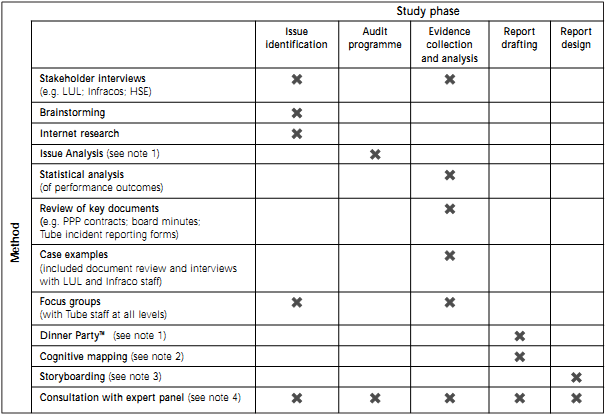
4 Issue analysis produces a series of yes/no questions that terminate in audit tasks that indicate what hypothesis the auditor should seek to test and what method of data collection and/or analysis he or she should use. The high level questions that we based this audit around were as follows:
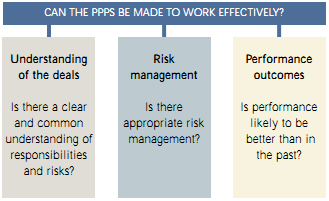
For each of the top level questions, we set a subsidiary group of questions, linked logically to the main question, in order to direct our detailed work and analysis.
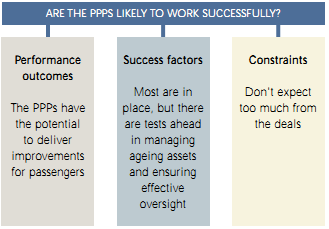
5 The Dinner Party™ is based around what happens at a real dinner party, when you typically have only a short period of time to hold a fellow guest's attention. The Dinner Party™ meeting takes place after data collection and analysis is complete and the aim is to produce crisp, interesting report conclusions that can each be stated in 10-15 seconds, and to build up more levels of detail on that basis. In this case, the high level conclusions that resulted from the Dinner Party™ process were:
_____________________________________________________________________________________
16 The approach is based in part on theory contained in The Pyramid Principle, by Minto B. (2002), 3rd edition, Harlow: Pearson Education, and the principles of argument mapping as for example set out in Horn, R.E., Yoshimi, J., et al. (1998) Mapping Great Debate: Can Computers Think?, Bainbridge Island, WA: MacroVu, Inc.