Common Features
2.1 Table 2.A (at the end of this Chapter) sets out the range of possible JV structures and the extent to which they are covered by this Guidance. For the purposes of this Guidance the JV can be viewed as either a company or a partnership. Annex B provides a more detailed comparison of three of the principal forms, i.e. companies limited by shares, limited partnerships and limited liability partnerships.
2.2 The parties who form the JV as shareholders in a company or members of a partnership are referred to in this Guidance as "participants". Those individuals responsible for the management of a JV are called "directors" (even though an individual with management duties within a partnership is not a "director" and does not have the same powers and duties as a "director" of a company) and references to the "Board" refers to the management committee of the JV, comprising the directors, responsible for the management and direction of the JV's activities. Directors nominated by the public sector body participants may or may not have any direct relationship with the particular public sector body or they may be employees or non-executive directors.
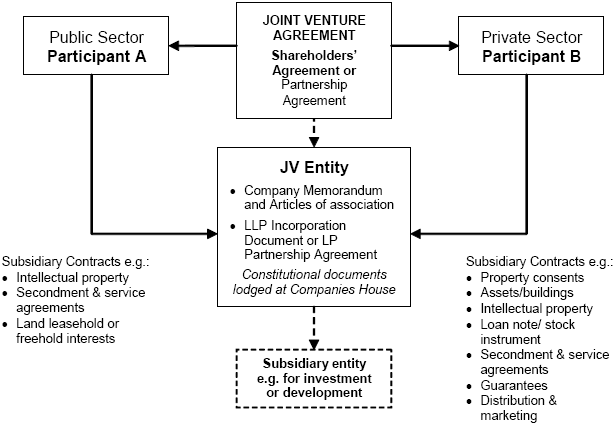
2.3 In each case there will be an agreement between the participants in the JV. Where the JV is a company this normally takes the form of a Shareholders' Agreement; in the case of a partnership, usually this is the Partnership Agreement. In this Guidance, this agreement is referred to in both scenarios as the "JV Agreement" (detailed information on the nature and content of JV Agreements is set out in Chapter 8).
2.4 Where the JV participants provide skills and incidental assets to the JV, this is often done under separate contracts (referred to in this Guidance as "subsidiary contracts"). For example, a participant may license existing intellectual property rights to the JV, lease or license land to the JV or second the staff required to carry on the JV's business (Chapter 6). The terms of these subsidiary contracts will impact upon the liabilities of the participants and the value of the JV.
2.5 Chart 2.A below illustrates a generic example of a public-private JV, which could be either a company or a partnership.
Chart 2.A: Generic example of a public-private JV
In this example the public sector participant provides access to intellectual property and some staff and services, and the private sector participant provides complementary skills and financial resources |
2.6 The different types of JV structure are briefly introduced with example case studies in the remainder of this Chapter.