The local partnership environment
15 Government influence over local joint working has developed over the last three decades (Figure 1).
Figure 1 From focused response to common prescription Some areas have three decades experience of joint working.
Source: Audit Commission, 2008 |
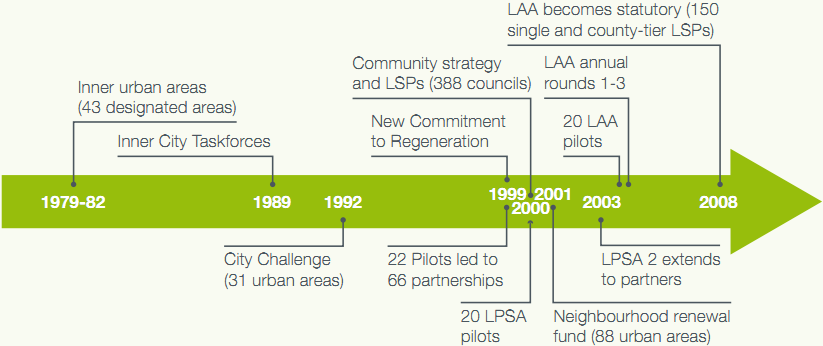
16 Government policy on joint working in the 1970s focused on specified areas and narrowly defined economic regeneration outcomes. This transformed during the 1990s into a wider focus on social and economic issues. From 2000, government attention shifted towards local objectives and joint working in all areas. Different councils have different experiences of joint working. The 43 areas designated in the 1978 Inner Urban Areas Act now have three decades' experience of joint working encouraged, incentivised, or mandated by government.
17 The first LSP guidance (Ref 1. 2001) advised councils to use an LSP to:
• prepare, and fulfill, a community strategy;I
• bring existing local plans, partnerships, and initiatives together;
• develop a local public service agreement (LPSA); and
• develop and deliver a local neighbourhood renewal strategy.
18 The government introduced voluntary LAAs in 2005 (Ref. 6). These provided the template for the statutory LAAs in 2008. LAAs focus on personal, social, and community outcomes that can be progressed over three years. The government has removed some obstacles to collaborative working, but it has also required some joint working (Table 1).
Table 1 Whitehall enabling local partnerships Removing obstacles to collaboration and encouraging or mandating joint work | |
Department | Action |
Communities and Local Government: • well-being powers • frameworks for partnership work • SCS • LAAs | Local Government Act 2000 Local Government and Public Involvement in Health (LGPIH) Act 2007 |
Department of Health: • removed some obstacles to joint working • enabled joint commissioning and integrated • mandated joint strategic needs assessment | Health Act 1999 (s.31) National Health Service Act 2006 (s.75) |
Department for Children Schools and Families: • suggested children's trust arrangementsI • removed some obstacles to joint working • enabled joint commissioning and integrated | Children Act 2004 |
Home Office/Ministry of Justice: • local crime and disorder reduction partnerships (CDRPs) | Crime and Disorder Act 1998 (as amended by the Police Reform Act 2002 and the Clean Neighbourhoods and Environment Act 2005) |
HM Treasury • proposed duty to provide an economic needs assessment | Devolving decision making: delivering better public services: refining targets and performance management (March 2004) (Ref. 7) |
Source: Audit Commission
19 Not all of these government initiatives fit neatly with the principles of devolved decision-making (Ref. 9). There is confusion about the extent to which LSPs are voluntary, the extent to which LSPs or their partners make decisions, and the relationship between statutory partnerships and LSPs (Ref. 10).
20 Government guidance in 2008 (Ref. 11) added more executive roles for LSPs, saying they should:
• identify the needs and ambitions of local communities, and resolve, or arbitrate between competing interests;
• coordinate the consultation and engagement activities of partners;
• produce an SCS with a shared local vision and priorities for action (based on data and evidence from the local area and its population);
• produce a single-tier or county-wide LAA based on the priorities identified in the local SCS(s);
• oversee local resource planning and alignment to achieve more effective commissioning and better outcomes; and
• review and manage progress against the priorities and targets agreed in the LAA, and ensure delivery arrangements are in place.
21 Despite these activities from creating a vision to reviewing and managing progress, LSPs remain a collection of organisations and representatives working together voluntarily. The LGPIH Act 2007 does not create legal relationships or duties between councils, LSPs, or LSP partners (Ref. 11).I
LSP membership |
The decision about LSP membership is a local one. Councils should ensure involvement of the relevant sectors at the right levels. Early guidance (Ref. 1) listed potential LSP members: but missed out significant local agencies, including registered social landlords. Later guidance stresses the principle of engaging representation from the public, private, and third sectors at the strategic level and in the relevant theme or operational groups (Ref. 11). Each LSP should also consider how it will engage with community and neighbourhood representatives. Representatives at the executive level should have direct or delegated authority to support agreed actions. |
22 LAAs, however, do create legal relationships. When the Secretary of State signs an LAA, it becomes a contract with the single tier or county council as accountable bodies (Ref. 11).
23 The "duty to cooperate partners", including district councils, police, fire and rescue services, and primary care trusts (PCTs), have a duty to agree and have regard to the LAA targets. Some LSP partners have a closer interest in achieving the LAA targets than others (Ref. 12).
24 The connection between LAAs and LSPs is not simple. All councils have a duty to prepare an SCS. They are recommended to do it through their LSP. But only single-tier and county councils are accountable bodies for the LAA. There are also other levels of complication in the LAA/LSP system:
• Some of the thematic partnerships coordinated by LSPs have their own statutory basis. CDRPs have a duty to work with named partners to tackle crime and disorder (Ref. 13). Local authorities and partners have a duty to cooperate to improve the well-being of children and young people (Ref. 14). Some local agencies have a duty to cooperate in their partnership, but not with LSPs.
• County councils have to work with the county and district LSPs to deliver the countywide LAA. A typical county has six or seven districts, but six have ten districts or more: each with an LSP and its own SCS.
• Counties are likely to have partners (police, fire and rescue, and health) with different geographical boundaries.
• London boroughs must take account of the Mayor's strategies in developing their SCSs (Ref. 15).
• Some councils have drawn up multi-area agreements (MAAs) that focus on economic development issues that cross council boundaries (Ref. 7). MAAs are voluntary, and councils negotiate funding flexibilities (including pooling) from central government, to deliver regeneration.
I The Sustainable Communities Act 2007 replaced the term 'community strategy' with 'sustainable community strategy'.
I The Audit Commission study Are We There Yet? Questioned the effectiveness of children's trust arrangements.
I In 2006 there were two LSPs constituted as companies limited by guarantee. One hundred and eighty-eight LSPs (91 per cent) were voluntary partnerships and 17 (8 per cent) were undecided.