The public sector 7S framework
31 LSPs can use the public sector 7S framework (Figure 3) to assess strengths and weaknesses in their methods for delivering SCS and LAA outcomes. The framework was originally a business strategy tool (Ref. 16). It has also been used to assess adult social care policy (Ref. 17).
32 The 7S framework stresses the interconnections between the different parts of partnership working. For example, it encourages members to review the connections between style of meetings, the mechanisms that provide performance information, and the standards that ensure they can trust information. For partnerships to be effective, each element of the framework must contribute to the SCS.
Figure 3 A framework for assessing local partnership working Hard and soft aspects of collaboration support the high-level goals of the SCS
Source: Adapted from Modernising Adult Social Care: What's Working (Ref. 17) |
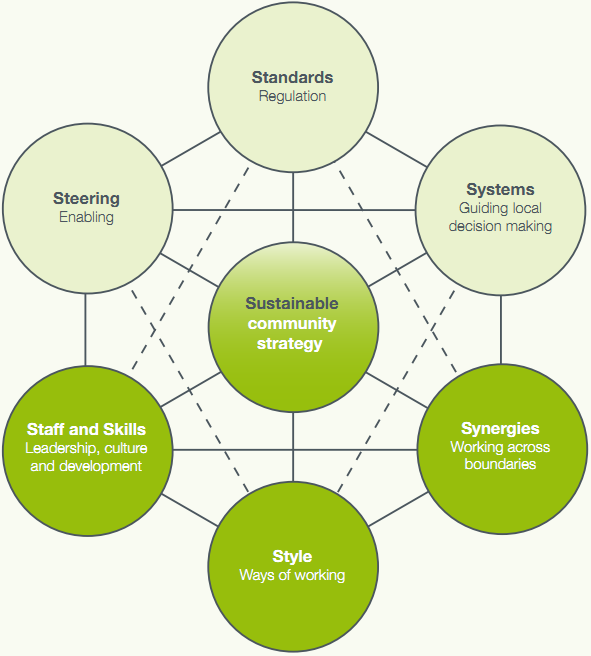
33 The framework balances softer aspects of joint working (staff and skills, synergies, and style) with harder aspects (steering, standards, and systems). Table 2 identifies and explains these for LSPs and links them to the issues discussed in Chapters 3 and 4.
Table 2 The 7S elements Effective partnerships must understand all seven elements | |||
| LSP context | Examples | 7S element |
| The long-term objectives of an LSP | SCS outcomes and goals | |
Softer aspects of partnership working: transformational | LSP leadership and culture | Ability and competence of political and officer leaders | Staff and skills |
Management and role of LSP meetings An LSP's approach to joint working | Chair's leadership style Meeting arrangements Relationships between individual partners LSP profile and promotion | Style | |
The benefits of joint working | Informal and formal social networks Shared services and efficiency projects | Synergies | |
Harder aspects of partnership working: transactional | Links between LSP objectives and partners' activity | Informal and formal social networks Shared services and efficiency projects | Steering |
Systems for understanding and influencing performance, resources, and risks | Levels of accountability | Systems | |
Rules for managing the partnership and its impact | Performance and resource management mechanisms Data quality standards | Standards | |
Source: Audit Commission, 2008
34 The Audit Commission reports Governing Partnerships (Ref. 2) and World Class Financial Management (Ref. 18) reviewed how these soft and hard factors influence effective organisational and partnership governance.
'The quality of financial governance and leadership within an organisation, the tone from the top, is critical to achieving world class financial management. Clearly, good basic systems, processes and controls are also important, but it is the overall financial culture of the organisation that really makes the difference.'
World Class Financial Management, Page 11
'Hard characteristics include reliable financial data, performance data and risk assessments, which are generated by robust systems and processes which produce timely and appropriate information for decision makers. The soft factors encompass leadership, which sets the overall objectives, the roles, and responsibilities required to achieve them and cultural attributes like openness, honesty and integrity.' Governing Partnerships, Paragraph 51
35 Academic studies of partnerships stress the importance of the balance between hard and soft, and the potential for an imbalance to undermine joint working (Ref. 21). LSPs can use the 7S framework to compare their own approaches with others, and assess the costs and benefits of their governance and management arrangements.