Long-term objectives (SCS objectives)
36 SCSs should provide a summary of long-term objectives that reflect local social, environmental and economic ambitions (Ref. 19). Each SCS should have four key ingredients:
• an outcome-led, long-term vision;
• an action plan focused on immediate priorities and actions for achieving long-term outcomes;
• a shared commitment to, and proposals for fulfilling, the action plan; and
• arrangements for checking performance, reviewing the SCS, and reporting progress to local people.
37 Each SCS should reflect local issues, but there are common themes. More than half of the 17 case studies referred to improving health (nine sites), developing the local economy (nine sites), and community safety (eight sites). The physical environment, and learning and skills (seven sites each) were also common. Some LSPs developed cross-cutting goals such as narrowing the gap between the poorest and wealthiest neighbourhoods (Ref. 20, Case study 1).
|
Case study 1 Narrowing the gap across a county Warwickshire's local public service board (LPSB) aims to narrow the gap between the most disadvantaged people and communities and the rest of the county. It used data from the Warwickshire Observatory to identify gaps at a district and ward level.I Getting partners to agree to a geographical shift in resource allocation was the biggest challenge, but it has paid off. 'You can see the commitment to narrowing the gap in the decisions that have now been made. The LPSB decision to put money into the shared vision…and to focus a disproportionate amount of resource on the north of the county will force greater scrutiny of…the outcomes that have been achieved.' District council corporate director £500,000 was redirected in 2008/09. The LSP in the district with the highest levels of deprivation takes the lead role across the county. It uses the county LPSB to influence the allocation of resources and the Warwickshire Observatory to provide data on progress towards delivering outcomes. Source: Audit Commission, 2008 |
38 Multi-tier areas face added challenges in developing agreed long-term objectives. There are scale (population and geographical) factors, as well as different accountabilities and responsibilities. County and district LSPs must establish relationships and then coordinate activities (Case studies 2 and 3).
| Case study 2 Agreeing SCS priorities in multi-tier areas A long-term shared vision with local implementation plans. The six local authorities and LSPs in East Sussex worked together during 2007 to produce an integrated SCS, Pride of Place, for 2008 to 2026. The partners agreed a shared vision and worked on plans to achieve it together. The integrated strategy sets the direction for future joint work. In children's services: 'One of the biggest determinants of life chances for children and young people is the ability of family and careers to support them emotionally and practically. The LSP intends to address these challenges by shifting more resources to early _identification and prevention.' Pride of Place, 2007 (Ref. 21) Source: Audit Commission, 2008 |
| Case study 3 Continuing high-level coordination Derbyshire's LSP Coordinators' Group brings county and district LSP representatives together every three months. They discuss issues and share experience. The group helps LSPs to avoid duplication and make the best use of resources. Dorset's Strategic Partnership Bridging Group involves the county and district LSP chairs, local authority representatives, the Dorset Town and Parish Council Association, and the third sector. It meets quarterly to manage the link between local and district level community planning and the county-wide strategy. It ensures that community engagement and planning within districts and parishes influences county-wide priorities and action. Source: Audit Commission, 2008 |
39 Government guidance on SCSs (Ref. 1) and LAAs (Ref. 22) stresses an evidence-based approach for objectives and targets. Partners should use knowledge about current issues and performance, and research about future challenges, to help meet LAA targets, keep the SCS up-to-date, and understand and manage risks.I
40 Recent national policy developments require LSPs to develop their evidence base in two further ways:
• PCTs and local authorities have to produce a joint strategic needs assessment (JSNA) of the health and well-being of their local community. The JSNA must be refreshed at least every three years and feed into the LAA. The JSNA should support longer-term strategic planning, commissioning, and the SCS (Ref. 23).
• The proposed local authority economic assessment duty will commence during 2010/11 (Ref. 24). County and single-tier councils will have to assess the economic conditions of their local areas when developing strategies and targets.
41 A strong evidence base should support the links between the SCS and the LAA (Figure 4). Over two-thirds (70 per cent) of the LAA targets agreed in 2008 were consistent with local SCS priorities. The remaining 30 per cent were evidence of the tensions between locally and nationally driven priorities, and the failure of national government to recognise local political and environmental issues (Ref. 25). In some of the case study areas there was a concern that government had pushed targets that were not local concerns. A strong evidence base should support the links between the SCS and the LAA (Figure 4). Over two-thirds (70 per cent) of the LAA targets agreed in 2008 were consistent with local SCS priorities. The remaining 30 per cent were evidence of the tensions between locally and nationally driven priorities, and the failure of national government to recognise local political and environmental issues (Ref. 25). In some of the case study areas there was a concern that government had pushed targets that were not local concerns.
| Figure 4 Overlaps and tensions between the SCS and the LAA LAA targets were not always consistent with SCS objectives
Source: Audit Commission, 2008 |
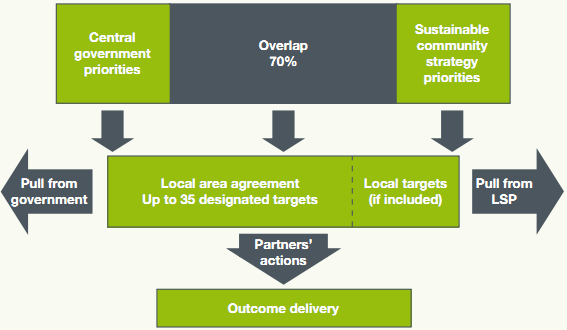
42 Housing and climate change are issues on which local authorities and partners felt a pull towards national policies rather than local issues. Housing was a local priority in five of the 17 case study areas; but the two housing indicators appeared in 11 of those areas' LAAs. Climate change was originally in two of the case study SCSs, but 11 of their LAAs have a climate change indicator.
43 Housing and climate change also show different aspects of the relationship between the SCS and the LAA, and between local and national government. Interviewees in case study authorities spoke of pressure to include housing targets, but accepted that new climate change targets illustrated how LAA negotiations stimulated a review of SCS priorities. Other research on LAA negotiations confirms the 'tensions between striking the balance between locally and nationally driven priorities' in some areas (Ref. 25).
I The Warwickshire Observatory is one of the data, research and intelligence observatories that have developed at regional and local level during the last decade to collate and interpret sub-national statistics: http://www.warwickshireobservatory.org/
I See Chapter 4.