Challenge
56 Willingness to challenge is a sign of personal and organisational trust and of partnership maturity (Ref. 4). It is important for effective joint working (Ref. 26).
57 The extent of challenge in LSPs is unclear. Over half of coordinators (58 per cent) think members challenge each other's performance, but only 44 per cent of the members agree. There are also differences between types of authority. Coordinators in counties, metropolitan districts, and London boroughs (80 per cent) are more likely to say there is performance challenge than those in district councils or unitaries (50 per cent).
58 Performance challenge is more likely in LSPs where the county or single-tier council had a strong CPA corporate capacity score.I Their partners say they are more likely to get information, to understand it, and feel confident in using it to challenge performance.
Case study 4 Vision and impact Bolton was one of the first areas to set up a broad, multi-agency, cross-sector partnership. The Vision Partnership started in 1995. The council knew that it was unable to solve cross-cutting problems alone. It recognised the potential for a partnership, based around a shared vision, to access funding streams and negotiate with regional, national, and European agencies. The council, with partners, uses its Access Points programme to coordinate shared physical assets. The programme incorporates the local NHS Local Improvement Finance Trust, extended services partnerships, neighbourhood policing arrangements, social care and neighbourhood centres, and third sector involvement. Bolton has 21 area-based extended services partnerships using schools, health centres and other buildings as access points. The Breightmet Health Centre, for example, includes a new library, funded with a Big Lottery Fund grant, alongside adult care services, mental-health services, a pharmacy and a full range of GP services. Source: Audit Commission, 2008 |
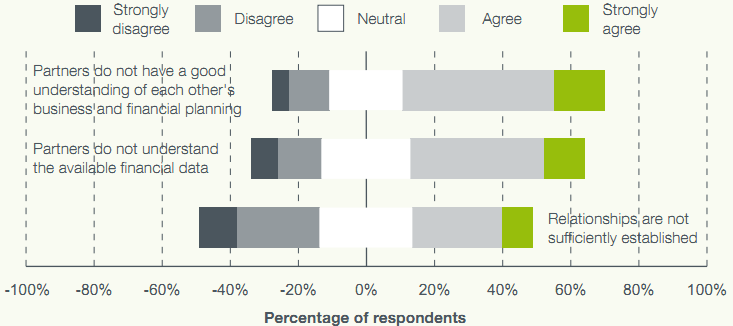
59 Most coordinators (72 per cent) and most partner representatives (62 per cent) agree there must be honest and challenging discussions about money. Yet financial challenge only occurs in a quarter of LSPs. There are three main barriers: partners do not understand each other's financial planning processes, they do not understand the available data, or they do not have good relationships (Figure 6).
Figure 6 Barriers to financial challenge Immature relationships and a lack of financial understanding are barriers to effective challenge
|
Source: Audit Commission LSP survey, 2008 |
60 Joint working requires trust and shared commitment at every level of an LSP and in the relationship with government offices.
'There is a language of partnership; there are expected behaviours and lists of things to do. But in my experience a lot of it is often down to key people.'
Council chief executive
'We have good relationships with the government office which is very important. They need to be a key player and supporter of the LSP and the LAA.'
Council director
'The relationships are excellent in terms of scrutiny and challenge and they genuinely support each other where there are areas of common ground.'
Government office locality manager
61 Trust and challenge require stability; organisational restructures are a particular problem.
'If the Department of Health starts playing around with boundaries again and moving everything around, you can destroy all those partnerships overnight by suddenly merging a load of PCTs and having to re-establish.'
Council finance director
'Still a concern generated by the existence of the unitary debate. The districts and borough councils have a strong concern that their identity and position is going to be jeopardised in some of these joint working relationships.'
District council corporate director
I Between 2002 and 2008 councils had regular Comprehensive Performance Assessments. These drew on performance indicators, assessments of corporate capacity, audit and inspection reports, and stakeholder opinions to reach a single judgement on performance. Comprehensive Area Assessment replaced CPA in 2009.