Commissioning
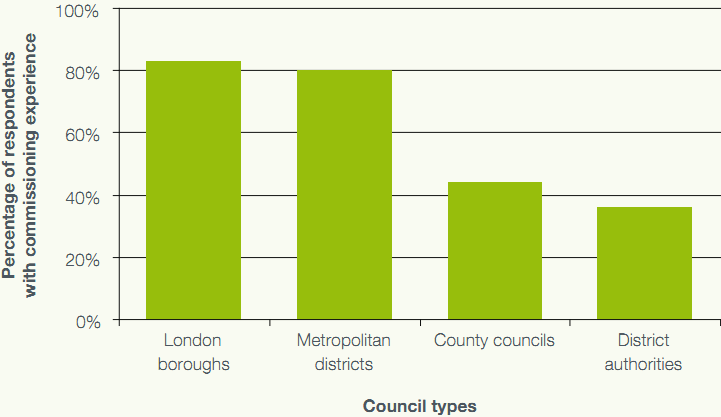
101 The opportunity for joint commissioning is one of the synergies that should arise from local joint working. While many LSPs have developed service commissioning plans, there are significant gaps (Figure 15). Metropolitan district and London borough LSPs have most experience of joint commissioning.
Figure 15 LSP commissioning experience County and district LSPs have less experience of commissioning through an LSP |
Source: Audit Commission, 2008 |
102 Statutory partners involved in established theme groups (children and young people, community safety health, supporting people), are likely to have experience of two-way or three-way joint commissioning arrangements.I
'The community safety group has a budget of about £0.5 million of LAA pooled funding and it operates a commissioning framework.'
Council manager
'The ones that have had funding for longer through the LAA have set up commissioning approaches [and] recruited staff. That's been the Children and Young People's Partnership, and the Safer and Stronger Communities Group.'
LSP manager
103 Involvement in commissioning should reflect the layers of partnership governance. The strategic layer sets overall direction and reviews overall progress. At the executive and operational layers, there are opportunities to influence detailed commissioning decisions by others. Accountability, however, remains with the council and the partners involved:
'All target-setting, and consequent financial, commissioning, or contractual commitments proposed by LSPs, must be formalised through the relevant local authority, or through one of the other LSP partners (for example, if policing, or health resources are involved).'
Ref. 11, Page 15
I The Audit Commission will publish a study on health and social care commissioning in 2009.