Performance information
120 Performance information frameworks provide a focus for standardization across LSP partners. Shared data and common approaches to performance help to join-up theme group activity. The Audit Commission's discussion paper on using information to make decisions sets out six principles that should guide LSPs (Ref. 44):
• Local services improve when decision makers use information well.
• Information must be relevant to the decision.
• Good quality data are the foundation of good quality information.
• The presentation of information is important for accurate interpretation.
• Analysts and decision-makers need particular skills to use information well.
• People need to think carefully about the information they use whenever they make decisions.
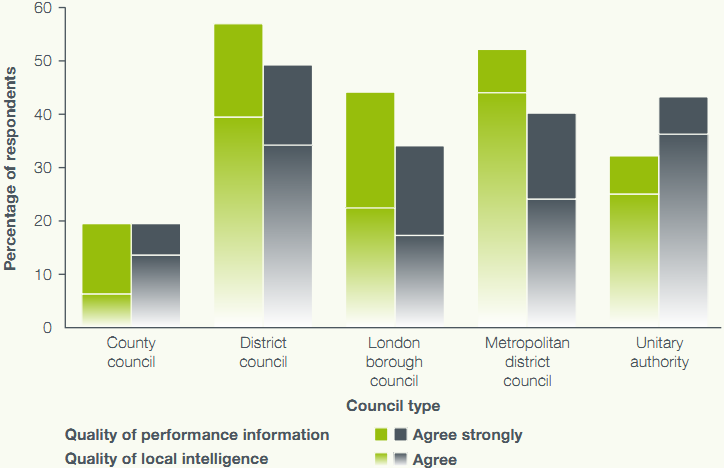
121 Failure to follow these principles creates barriers to successful outcomes in many LSPs (Figure 16).
| Figure 16 Poor quality of information and intelligence are barriers to success |
|
Source: Audit Commission LSP survey, 2008 |
122 Case study interviews identified three main obstacles to effective information sharing:
• incompatible systems;
• incompatible data formats (due to different government reporting requirements); and
• partners unwilling to share information.
123 Some LSPs have overcome these problems. The Warwickshire LSP uses the local observatory to develop the evidence base that local partners use to agree priorities, keep the SCS up-to-date, and monitor progress on SCS and LAA outcomes.
'The Warwickshire Observatory is really helpful in terms of actual evidence to back up what you're trying achieve.'
District council director
124 Derbyshire uses area and neighbourhood data to provide the evidence base for LAA priorities and targets and to monitor performance (Case study 19).
| Case study 19 Derbyshire LSP uses the Quilt to help it agree priorities Derbyshire's LSP commissioned the county council to develop area profiles based on the ten Audit Commission quality of life themes (Ref. 44): • people and place; • community cohesion and involvement; • community safety; • culture and leisure; • economic well-being; • education and lifelong learning; • environment; • health and social well-being; • housing; and • transport and access. The profile for each of Derbyshire's 42 communities has more than a hundred pieces of information. Derbyshire also produces a summary profile, the Quilt, with 33 key statistics for each community. Colour-coding of performance and outcomes gives LSP members and local managers an at-a-glance comparison of all the areas and performance issues (see illustration) supported by underlying statistics and more detailed analysis. The Quilt enables the Derbyshire Partnership to redirect funding to areas with greater need: in 2008 Chesterfield and the High Peak received additional community safety resources. Source: Audit Commission, 2008 |
125 Derby City Partnership developed a shared data quality policy in response to partners' concerns about obstacles to data sharing (Case study 20). The original focus was on the LAA: the policy now covers SCS performance and other shared measurement and reporting activity.
| Case study 20 Derby City Partnership's shared policy for data quality The LSP's data quality framework covers the performance measurement, reporting, and risk arrangements for the SCS, LAA, theme group plans, partner strategies and plans, and service and business plans. It follows the six Audit Commission data quality dimensions (accuracy, validity, reliability, timeliness, relevance and completeness) (Ref. 43). The policy describes the roles and responsibilities of compiling officers, accountable officers, performance leads, assistant directors or senior managers, directors, and lead members. The policy also uses the Audit Commission standards for better quality data (governance and leadership, policies, systems and processes, people and skills, and data use and reporting) (Ref. 45). The standards support the partnership's action plan for implementing the policy. There is a review of the policy and the action plan every six months. The LSP has a commitment to common data quality standards. It has arranged training on data quality for LSP board and elected members. There is also a data quality self-assessment for each organisation. There are plans for peer spot checks. The data quality policy has improved the consistency of performance risk assessments and made auditing of the second round of LPSAs easier. The partnership now uses a self-assessment of data quality compliance. Source: Audit Commission, 2008 |