LSP support teams
127 LSPs are unincorporated associations with no employees: but they still need people to develop and manage their systems. Almost all LSPs have a support team that supports policy and strategy development, organises meetings, and provides finance, resource and performance data to partners. Support teams also do research and commission projects for the LSP.
128 Councils employ most of the people working in these core teams. It is only in the metropolitan districts that the majority (72 per cent) of core teams includes staff from other partners. The money available for research and commissioned projects is usually less than £50,000 a year. Budgets are larger when councils and partners have a shared commitment: one in ten jointly funded budgets is greater than £500,000.
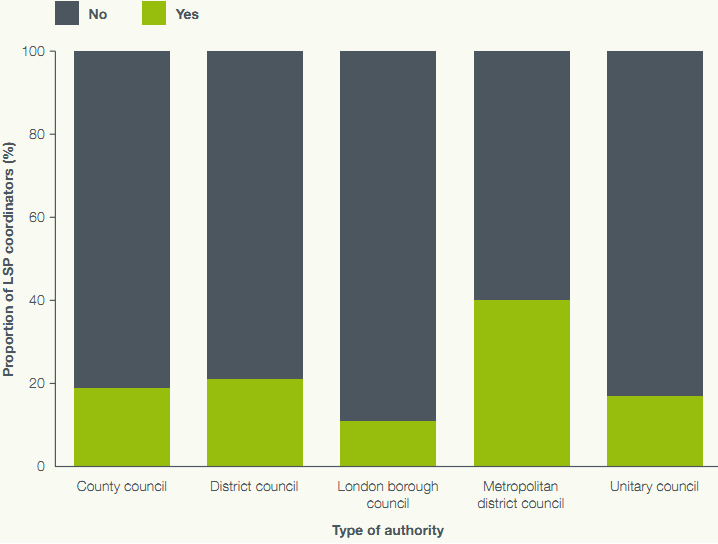
129 Most local councils, and their LSP partners, are unaware of the costs of their support teams (Figure 17).
Figure 17 Most LSPs don't know their support team costs |
Source: Audit Commission LSP survey, 2008 |
130 LSPs that know their support costs can make informed decisions about value for money (Table 9). They are also in a stronger position to agree about different partners' contributions, in cash or kind, to the LSP support team's work.
Table 9 Reviewing the LSP support |
Self assessment questions |
• What are the LSP support costs for: |
- policy and strategy support? |
- research and intelligence? |
- information gathering and presentation? |
- conferences, meetings and events? |
- website commissioning and maintenance? |
• How do different partners contribute to the LSP support costs? |
- Is the LSP making the best use of contributions in kind? |
- Do contributions reflect partners' involvement in LAA and SCS outcomes? |
• Does the LSP have a budget for policy development? |
- How do partners contribute to the development budget? |
- How has the LSP planned and reviewed its development budget? |
• Does the LSP get the right balance between research, development, and administration from its spending? |
• Does the support team effectively support the LAA and SCS? |
- Is information for decision-making accurate, valid, reliable, timely, relevant, and complete? |
- Is the evidence base to support prioritisation kept up-to-date? |
- Does LSP administration represent good value for money? Source: |
Source: Audit Commission, 2008