Joining up resources
131 Partners can contribute human, capital and financial resources: they need confidence that these resources are allocated properly and used effectively.
132 LSPs use five main arrangements for financial resources:
• pooling;
• aligning;
• grants or transfers;
• procurement; and
• partnership arrangements.
133 Pooling and aligning both allow partners to apply financial resources to LAA and SCS priorities.
'The money in the LAA 'pot' comes from existing funds. Occasionally the money is pooled into a central fund managed by the top tier authority. The LSP allocates the money to meet the LAA priorities.
In other cases, LSP partners have agreed to align funds, which means that each organisation still administers its own money but it will agree to use it to achieve the targets in the LAA.'
Police finance officer
134 Pooled budgets allow partners to bring funds together to achieve economies of scale (particularly administration costs) from resources that would be too small to make a difference by themselves. The pooled budget manager can use the combined resources to commission services or goods. But pooled fund arrangements are subject to constraints (Table 10).
| Table 10 Constraints on pooled budgets Some constraints reflect different government department's rules |
| Membership of the pool can be limited: • to local authorities and NHS bodies for health and social care pools (Ref. 47);I or • to children's service authorities and duty to cooperate partners for children's service pools (Ref. 48). |
| There are different VAT rules for local authorities and the NHS. If the pool host is in the NHS then limited or no VAT can be reclaimed, but if the host is a local authority then full or partial VAT reclamation is possible. |
| Health and social care pools must be supported by a written agreement between the parties. The agreement must include mandated content and it must be registered with the Department of Health. The agreement must show that pooling is the most effective use of NHS resources (Ref. 47). |
| Pooled funds have no separate legal existence. Fund hosts must ensure that pooled fund income and spending is properly accounted for, that performance is reported on, and that end of year under (or over) spending is properly reported in partners' accounts (Ref. 49). |
Source: Audit Commission, 2008
135 LSP members must be clear why they have chosen a particular financial arrangement. Table 11 suggests factors that should inform choices between pooling and aligning finance.
| Table 11 Aligning and pooling | |
| Aligning is more suitable when: | Pooling is more suitable when: |
| • LSP objectives are better supported by organisations redirecting their mainstream activity rather than by funding a discrete service or activity. | • There is a clear, discrete service or activity that one organisation can deliver most effectively. |
| • There are significant differences between the contributions made by different members (and some members may not make financial contributions). | • All parties to the arrangement make proportionate financial contributions. |
| • The arrangement includes private sector and | • The arrangement includes only the statutory members of an LSP. |
| • Arrangements need to keep a high degree of | • Arrangements need to keep a high degree of service responsiveness. |
| • Parties to the agreement continue to provide | • The host will provide frontline services for all the members. |
| • Performance monitoring and review systems in the member organisations can provide enough confidence that LSP objectives will be achieved. | • The host's financial and performance monitoring and review arrangements can provide confidence that LSP objectives will be achieved. |
| • The administration and other costs of pooling would exceed the benefits. | • The benefits of pooling exceed the administrative and other costs of setting up and maintaining the pool. |
| • Legal or other constraints make pooling difficult or impossible. | • There are no legal constraints to pooling. |
Source: Audit Commission, 2008
136 LSPs will have a mixture of pooling And aligning. Whether partners choose pooling or aligning, they should be clear about the standards that govern resource and performance matters. Table 12 outlines the main issues that partners should consider in settling the terms of agreement for aligning or pooling.
| Table 12 Issues to settle before aligning or pooling resources | ||
| Self-assessment question | Aligned | Pooled |
| Who are the parties to this agreement? |
|
|
| What outcomes are we trying to achieve? |
|
|
| What are we going to do? |
|
|
| Who will benefit, and how will they be informed, consulted, and involved? |
|
|
| How will we monitor and report on performance? |
|
|
| How much money will each partner contribute? |
| |
| How will we vary payments if we need to? |
| |
| What other resources will we contribute? |
|
|
| How will we vary contributions if we need to? |
| |
| What will we do to make sure that over or under spend is properly accounted for? |
| |
| Who is the named host accountable for this agreement? |
| |
| How long will this agreement last - and how will we end or extend it? |
|
|

Source: Audit Commission, 2008
137 LSP partners perceive local obstacles to pooling or aligning (Table 13).
| Table 13 Perceived local obstacles to aligning and pooling LSPs must tackle these obstacles if resource alignment is to become a reality | ||
| Obstacle to aligning (%) | Obstacle to Pooling (%) | |
| Different organisational cultures | 74 | (not recorded) |
| Poor understanding of others' financial planning and governance arrangements | 59 | 60 |
| Internal financial pressures | 56 | 52 |
| Confusing of accountability to government departments | 44 | 48 |
Source: Audit Commission, LSP 2008 survey
138 One effect of these obstacles is that fewer than half of the respondents to the 2008 survey could identify budgets their organisations had aligned with LAA or LSP priorities.
| Figure 18 Fewer than half of local agencies align budgets with agreed priorities |
|
Source: Audit Commission LSP survey 2008 |
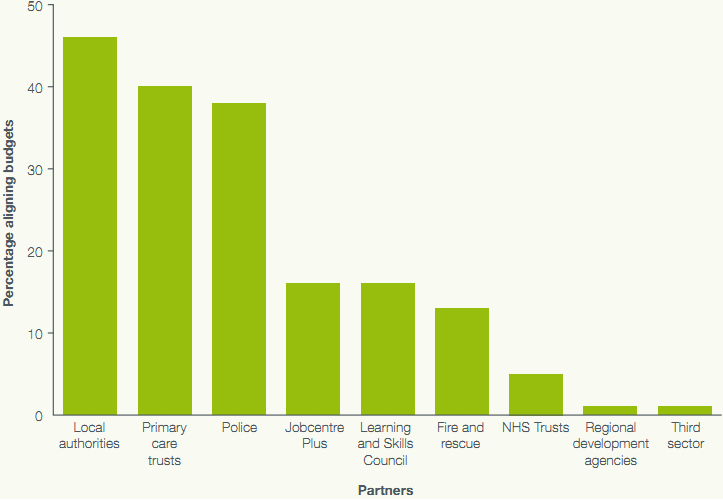
139 Local partners expect, though, that statutory LAAs will create stronger incentives to resource alignment (76 per cent of LSP coordinators and 60 per cent of local partners agree).
140 There are other ways, usually at the executive or operational layer, that partners can bring financial resources together:
• Grants, or transfers between LSP members. One organisation delivers a seamless service for the LSP. One-off grants can support specific initiatives or projects.
• Grants to representative groups.
These grants often enable local bodies representing local business, the voluntary sector, and community organisations to take part in the LSP.
• Trading services between partners. Where partners have the powers to trade with one another they can use the LSP to support the creation of joint and shared services (Ref. 47).
• Partnership arrangements. Companies, joint committees, or community interest companies can provide a formal framework for particular aspects of local joint working.
I NHS Act 2006 section 75, this replaces Health Act 1999 section 31. Pooled funds are often referred to as 'section 31 agreements'. The specified NHS bodies are PCTs, strategic health authorities, NHS trusts, and foundation trusts.