Introduction
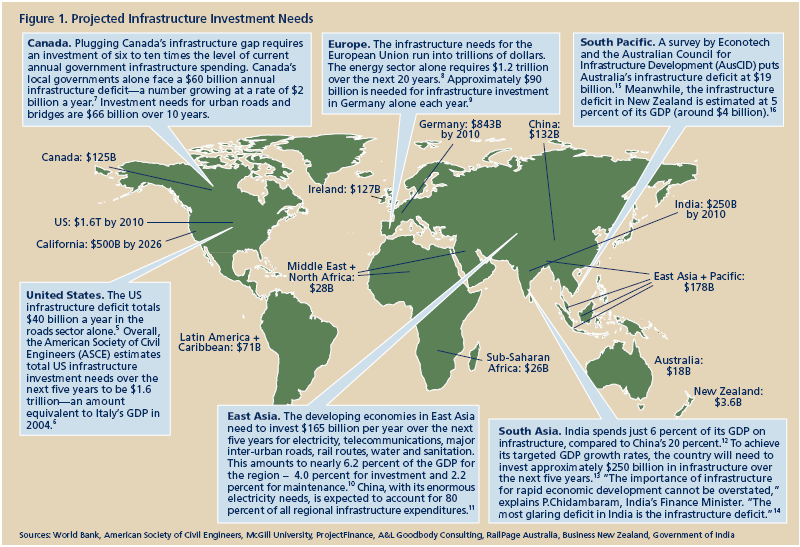
Citizens from New Delhi to New York confront the world’s glaring infrastructure deficit daily. From country to country, the large and growing gap between infrastructure needs and the resources governments have historically invested in meeting those needs is obvious everywhere: congested roads; bridges in need of repair; poorly maintained transit systems and recreational facilities; and deteriorated hospitals, schools and waste treatment facilities all in urgent need of rehabilitation and repair (see figure 1). Governments promise many new projects to close the gap, but often do not or cannot find the funding to follow through on their promises.
These problems in turn impose huge costs on society, from lower productivity to reduced competitiveness to an increased number of accidents. The Federal Reserve Bank of Chicago, for example, estimates that more than half of the decline in labor productivity growth rates in the United States during the 1970s and early 1980s resulted from infrastructure neglect.3 Meanwhile, in Latin America, the productivity and competitiveness of many regional companies have been lowered because inadequate transport infrastructure has increased logistics costs. In Canada, National Highway System roadways have deteriorated so badly that more than $17 billion in investment is required to restore them to an acceptable safety standard.4
Less well understood than the growing infrastructure deficit, however, is the revolution taking place in the way governments are tackling the problem of closing this gap.
In little more than a decade, a paradigm shift has occurred in how governments provide infrastructure. From Tokyo to Toronto, private sector financing, design, construction and operation of infrastructure has emerged as one of the most important models many governments use to close the infrastructure gap. Once rare and relegated to a handful of countries and infrastructure sectors, these public-private partnerships (PPPs) are delivering new and refurbished roads, bridges, tunnels, water systems, airports, schools, hospitals, social housing, and prisons. These PPPs involve long-term contractual relationships between government agencies and their private sector partners for the provision of an infrastructure asset or the delivery of a service (see nearby box "Public-Private Partnerships 101" for a description of the various PPP approaches).