Public-Private Partnerships 101
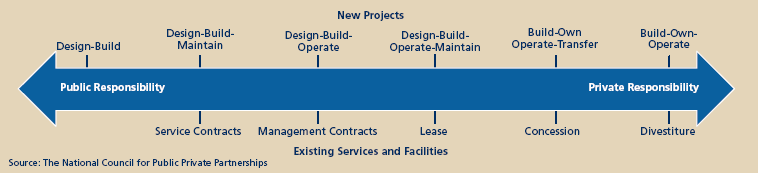
Public-Private Partnerships 101A public-private partnership, or PPP, refers to a contractual agreement formed between a government agency and a private sector entity that allows for greater private sector participation in the delivery of public infrastructure projects. In some countries involvement of private financing is what makes a project a PPP. PPPs are used around the world to build new and upgrade existing public facilities such as schools, hospitals, roads, waste and water treatment plants and prisons, among other things. Compared with traditional procurement models, the private sector assumes a greater role in the planning, financing, design, construction, operation, and maintenance of public facilities. Risk associated with the project is transferred to the party best positioned to manage it. Some of the most common PPP models are described below. Design-Build (DB): Under this model, the government contracts with a private partner to design and build a facility in accordance with the requirements set by the government. After completing the facility, the government assumes responsibility for operating and maintaining the facility. This method of procurement is also referred to as Build-Transfer (BT). Design-Build-Maintain (DBM): This model is similar to Design-Build except that the private sector also maintains the facility. The public sector retains responsibility for operations. Design-Build-Operate (DBO): Under this model, the private sector designs and builds a facility. Once the facility is completed, the title for the new facility is transferred to the public sector, while the private sector operates the facility for a specified period. This procurement model is also referred to as Build-Transfer-Operate (BTO). Design-Build-Operate-Maintain (DBOM): This model combines the responsibilities of design-build procurements with the operations and maintenance of a facility for a specified period by a private sector partner. At the end of that period, the operation of the facility is transferred back to the public sector. This method of procurement is also referred to as Build-Operate-Transfer (BOT). Build-Own-Operate-Transfer (BOOT): The government grants a franchise to a private partner to finance, design, build and operate a facility for a specific period of time. Ownership of the facility is transferred back to the public sector at the end of that period. Build-Own-Operate (BOO): The government grants the right to finance, design, build, operate and maintain a project to a private entity, which retains ownership of the project. The private entity is not required to transfer the facility back to the government. Design-Build-Finance-Operate/Maintain (DBFO, DBFM or DBFO/M): Under this model, the private sector designs, builds, finances, operates and/or maintains a new facility under a long-term lease. At the end of the lease term, the facility is transferred to the public sector. In some countries, DBFO/M covers both BOO and BOOT. PPPs can also be used for existing services and facilities in addition to new ones. Some of these models are described below. Service Contract: The government contracts with a private entity to provide services the government previously performed. Management Contract: A management contract differs from a service contract in that the private entity is responsible for all aspects of operations and maintenance of the facility under contract. Lease: The government grants a private entity a leasehold interest in an asset. The private partner operates and maintains the asset in accordance with the terms of the lease. Concession: The government grants a private entity exclusive rights to provide operate and maintain an asset over a long period of time in accordance with performance requirements set forth by the government. The public sector retains ownership of the original asset, while the private operator retains ownership over any improvements made during the concession period. Divestiture: The government transfers an asset, either in part or in full, to the private sector. Generally the government will include certain conditions with the sale of the asset to ensure that improvements are made and citizens continue to be served.
|
| ||
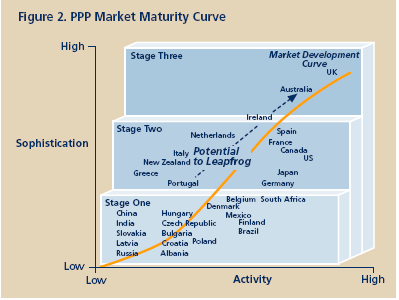
| Stage One |
|
| • Establish policy & legislative framework • Initiate central PPP policy unit to guide implementation • Develop deal structures • Get transactions right & develop public sector comparator • Begin to build marketplace • Apply early lessons from transport to other sectors |
|
| Stage Two |
|
| • Establish dedicated PPP units in agencies • Begin developing new hybrid delivery models • Expand and help shape PPP marketplace • Leverage new sources of funds from capital markets • Use PPPs to drive service innovation • PPP market gains depth-use is expanded to multiple projects |
|
| Stage Three |
|
| • Refine new innovative models • More creative, flexible approaches applied to roles of public & • Use of more sophisticated risk models • Greater focus on total lifecycle of project • Sophisticated infrastructure market with pension funds & • Public sector learns from private partner methods as • Underutilized assets leveraged into financial assets • Organizational & skill set changes in government implemented |
|
Instead, countries at earlier stages of PPP development could benefit from the opportunity to learn from the trailblazers who have moved to more advanced stages: the United Kingdom for schools, hospitals and defense facilities; Australia and Ireland for roads; and the Netherlands for social housing and urban regeneration. Latecomers to the PPP party can avoid some of the mistakes often made in earlier stages of maturity, such as the tendency to apply a one-size-fits-all model to all infrastructure projects. And they can adopt from the outset some of the more flexible, creative and tailored PPP approaches now being used in trailblazer countries. This approach would allow them to move up the PPP maturity curve more rapidly and leapfrog to more advanced stages of maturity.
As for those countries higher up the maturity curve, most have only recently begun to use PPPs in more than one or two infrastructure areas. And with the exception of the United Kingdom, many also have experience with only a handful of different PPP approaches. Before these countries expand their use of PPPs into new sectors such as education, health care, and defense, it is important for them to develop a deep understanding of the challenges and potential solutions particular to each infrastructure area.
The purpose of this study then is to provide a roadmap for governments at all stages of PPP development, showing them how to move up the maturity curve and take public-private partnerships to the next stage. This approach, in turn, will enable this relatively new delivery model to play a far larger role in closing the infrastructure gaps bedeviling governments across the world.
Toward this end, we begin with a short discussion of the benefits governments can achieve by using PPPs.