Go Beyond the Transaction: Adopt a Life-cycle Perspective
To be sure, it's important to get the financial terms of the initial deal right. But equally critical is getting stakeholder buy-in; managing the change process; correctly allocating risk; developing the legislative and regulatory framework; and analyzing the long-term effects of the project on the larger sector, such as the rest of the transportation network or the hospital system. This means developing from the very outset a holistic view of the infrastructure project's entire life cycle.
A life-cycle view helps to get better 'buy in' from all parties involved. It also provides a framework for evaluating whether the solution is the most appropriate for the public over time. Without such a holistic view, on the other hand, public officials will be unable to plan in advance for key considerations that-if not properly accounted for-can stymie efforts to move beyond the transaction stage.
A life-cycle approach best ensures the interest of the government agency that retains ownership and ultimate responsibility for the asset throughout the life-cycle. While many experts emphasize the transaction phase of PPP transactions, the success of the project is actually heavily dependent on a sound policy and legal framework, effective risk allocation, a well-executed procurement process, strong project management, and close attention to the concession phase.
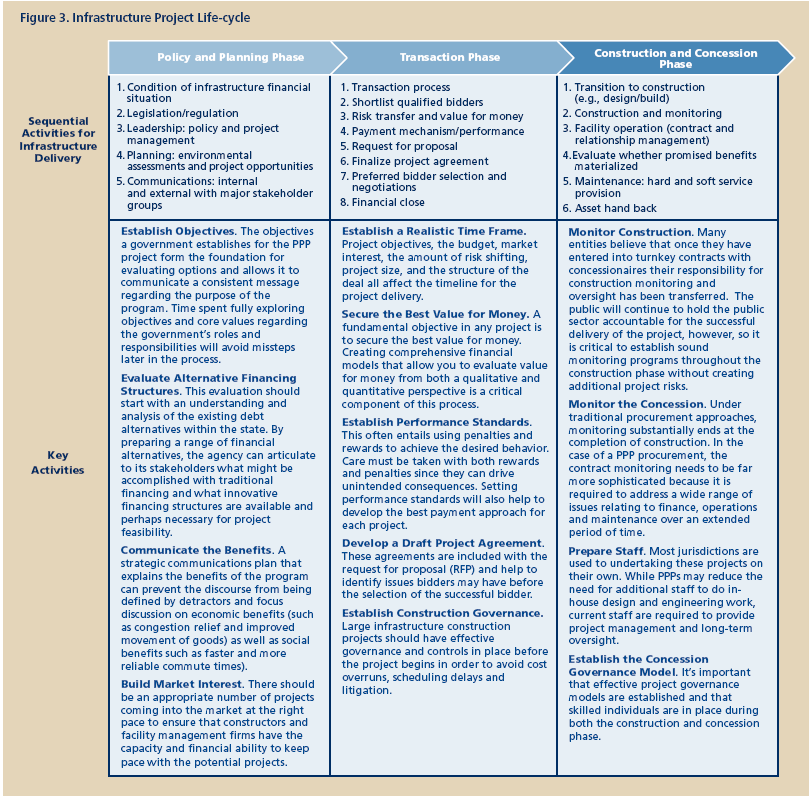
A life-cycle perspective helps governments understand how decisions made during different phases will affect the long-term success of the project. For example, the way a project is monitored will be determined largely by how much risk is transferred to the private sector during the transaction construction and concession phases. As shown in figure 3, there are three major phases for an infrastructure project under an innovative finance approach.
Policy and planning phase. In the policy and planning stage, a jurisdiction must determine whether it will use innovative funding to meet its infrastructure needs. Some of the activities performed in this phase include defining the jurisdiction's goals and objectives; issuing major guidelines for PPPs; developing the legal framework; designing a standard framework to drive down costs; establishing processes for receiving and qualifying candidate projects; outlining the role PPPs will play in the larger infrastructure program; setting the procurement process; analyzing stakeholder interests; and communicating both internally and externally (see Figure 3).
A key requirement during this phase is establishing the necessary legislative and regulatory framework to support the PPP program. With governments worldwide competing to attract investment capital, a poor legislative and statutory environment will stymie a government's efforts to engage in PPPs. The main features of a legislative framework conducive to PPPs are outlined in the sidebar box on page 13.
Governments also need to evaluate existing legal systems to ensure that the enabling legislation has the appropriate corporate and commercial laws in place to support private investment. In many countries, private sector involvement in the provision of basic public services is a new concept. Aspects of the broader legal and regulatory environment for services, such as laws governing accounting practices, construction contracts, public works and conventions, and so on, can act as significant barriers to the PPP. Therefore, a thorough examination of the existing legislative and regulatory framework must be undertaken to ensure that there are no distortions in the overall incentive environment (the tax regime, labor laws and banking, foreign exchange, import and foreign investment restrictions).
Establishing a central PPP unit to set policies and drive the process has also proven helpful during the first phase. The government of Victoria state in Australia, for example, set up Partnerships Victoria early in the process to aid in establishing a market for PPPs and setting out detailed policy documents on how the process would work in the state. Similar organizations have been established in British Columbia, Ontario, the United Kingdom and elsewhere. An important function of such organizations is developing standard gateway review processes that each PPP project must pass before the deal can move forward. The purpose: to bring consolidated knowledge, standardized processes and best practices to bear on each transaction, as well as to bring more certainty to the market.
Features of a Legislative Framework Conducive to PPPs • Give public entities considerable flexibility in the types of agreements they may enter into and in the specific procurement process • Allow contracts to be awarded according to best value, not just low price • Allow mix of public and private dollars • Allow "mixed concessions" (such as the reconstruction or expansion and long-term operation of existing facilities) • Allow long-term leases of existing government assets • Authorize procedures to receive and consider unsolicited proposals • Avoid provisions that would require further legislation to authorize or finance a project, execute a franchise agreement or change toll rates. Source: Nossaman, Gunther, Knox, & Elliot |
Transaction phase. With more than 2,500 kilometers of roads, Birmingham is known as Britain's motor city. Years of deferred maintenance and insufficient investment, however, have left the roads in this major transportation hub in relatively poor shape-12 percent of the city's road network has less than five years of remaining life. Moreover, congestion imposes huge costs to businesses operating in the region-estimated costs at about £1.5 billion a year in wasted time and fuel alone.
To address this problem, Birmingham is planning to turn over the city's entire road network to the private sector in a truly unique public-private partnership.33 The project requires the private contractor to upgrade the highway infrastructure to a specified set of standards and then maintain them over the 25-year concession period. The contract will cover all aspects of road structure, including lighting, drainage, bridges and tunnels. The goal: to create more certainty around the long-term maintenance and upgrade of all aspects of the road and bridge infrastructure.
Realizing this goal is easier said than done. The government needs to get a whole series of things right during the transaction phase (and subsequently during the construction and concession phase) to ensure the success of this approach. This includes establishing clear and achievable performance standards; building in the right mixture of financial incentives for good performance and penalties for poor performance; and determining the optimal amount of risk to shift to the private sector.34 The emphasis is to manage a competitive procurement that provides the best value for the public owner and meets the specific requirements of the project within defined procurement rules.
An important requirement of the transaction phase is protecting the public's interests. At every stage of the process, from initiation to the ongoing management of the partnership, government officials must ask key questions such as: What are the core values the government must protect? How can public officials maintain the integrity of these values? Answering these questions requires working through important issues, such as access to services, cost to citizens, fairness and equity, conflicts of interest, financial accountability, stability, and quality.
Construction and Concession phase. During this phase the private partner operates the infrastructure facility, while the government provides oversight. Two major activities encompass this phase: construction and maintenance and operation. While the issues involved in each activity are substantially different (see figure 3), in both cases, careful attention to the terms and conditions of the contract and incentive methods will pay off. Public officials will want to form a close partnership with the infrastructure partner in order to achieve the public goals and objectives for the project.
A critical element of this phase is setting up an effective governance structure for the partnership. Public officials must be careful to retain control of outcomes even while their private partners directly manage operations and services. This requires a delicate balancing act, building in the needed flexibility to enable dynamic change, while not becoming a captive of private vendors. Toward this end successful partnerships typically establish some kind of forum where contractors, government officials and stakeholders come together to solve problems and resolve conflicts.35 Success depends on quickly identifying and resolving any points of friction. Joint governance structures that address strategy, management and organizational activities can frame a successful partnership by setting out the overall vision, bringing bones of contention between the public and private partners to the forefront early on, anticipating problem areas and establishing a way of handling them.
Many local governments in the United Kingdom have established partnership boards to maintain direct contact between private service providers and government agencies working in public-private partnerships. The boards provide a forum where government officials and their partners craft mutual objectives, articulate local priorities and make joint decisions. The forums are also a good way to track results which in turn helps build public sector support for future PPP projects. Understanding that not all partner issues need necessarily rise to a board level, some governments have even created multiple partnership governance arrangements.
It must also be recognized that asking private partners to produce government services places more-not less- responsibility on public officials. It requires governments, often with declining resources, to provide more public service than before, but produce less of it themselves. This in turn demands a different set of governmental abilities: managers skilled in negotiation, contract management and risk analysis who will tackle problems unconventionally and focus on results rather than on defending bureaucratic turf.
The presence of a small cadre of managers with strong relationship management skills will help to ensure that issues that arise in a long concession relationship can be addressed before litigation becomes necessary. When the Netherlands initiated its first highway PPP, for example, the government and the private partner held "alignment meetings" when they faced cooperation problems. These informal meetings, attended by the key team members of both sides, were aimed at de-escalating problems.