There are barriers to resourcing specific assurance requirements
3.9 The Authority has access to too limited a pool of assurance reviewers. Staff for review teams are employed by departments and accredited by the Authority. They are drawn from a pool of 39 active review team leaders and 448 active review team members across government as at January 2012 ('active' means someone who has completed a review in the last 18 months). The reviewers agree to give their services to the Authority for a period of up to a week (depending on the nature of the review) at least twice a year.
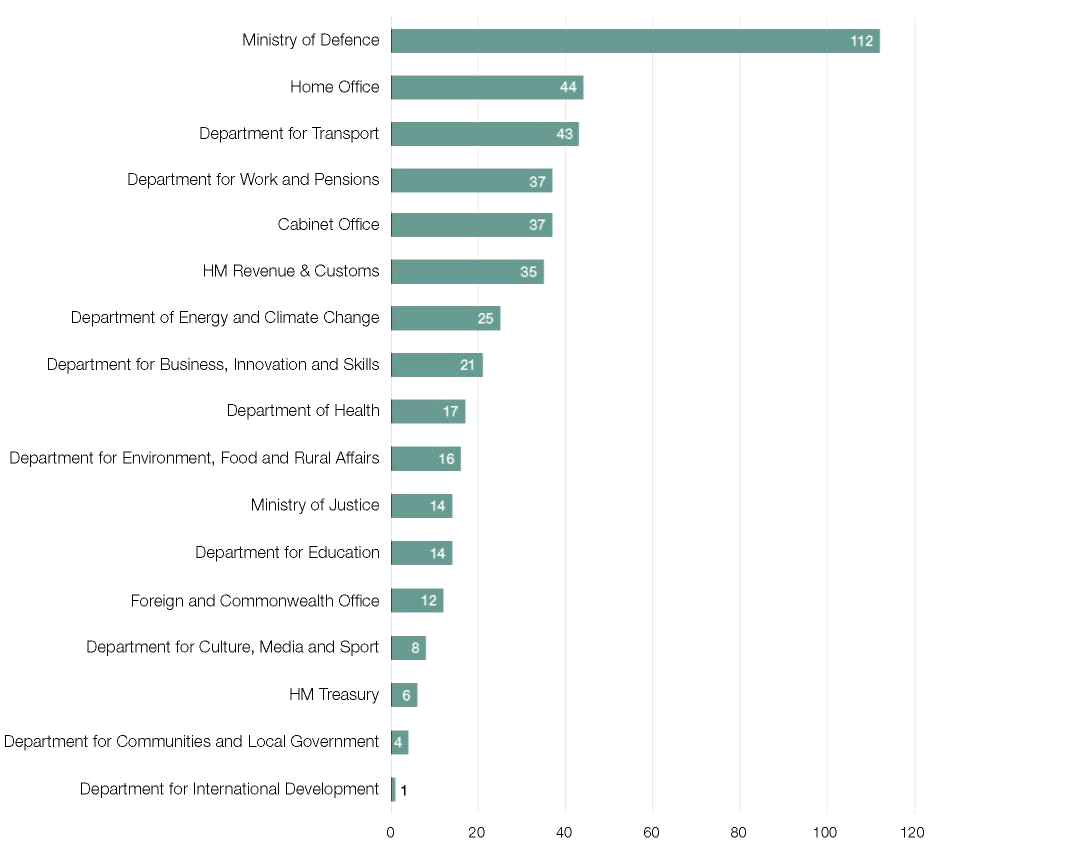
3.10 Departments are not providing the Authority with the number of reviewers it needs. Only the Efficiency and Reform Group (within the Cabinet Office) requires staff to carry out this role. Our 2011 report Identifying and meeting central government's skills requirements 17 found that there are significant barriers preventing skills being deployed between departments, and that departments have no incentive to release skilled staff when they are needed elsewhere. Figure 9 shows the large variation in the number of active qualified reviewers of high-risk projects employed by departments.
3.11 There should be more obvious benefits to staff of qualifying as a major project reviewer. Developing project delivery skills, and using these to carry out assurance reviews, are not criteria for progressing as a civil servant. The Australian Federal Government is increasing the number of staff available for review teams by including it as a way for senior civil service staff to show the competency requirement for cross-government working. Senior management at Fujitsu (one of the UK's largest ICT companies) believe that project assurance is a critical project management process that should be invested in, and their project management staff are regularly given assignments in its assurance function.
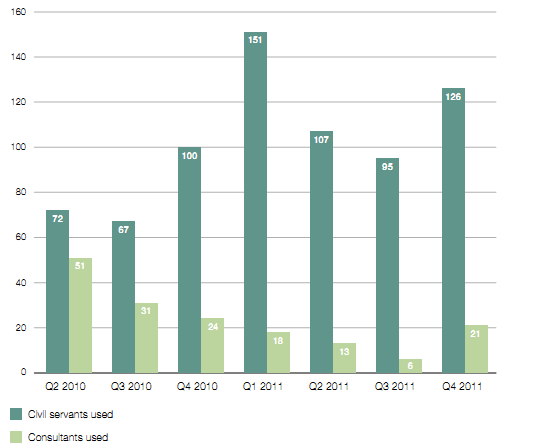
3.12 Controls on using consultants are exacerbating the Authority's resource constraints.18 Previously, when staffing assurance reviews was the responsibility of the Office of Government Commerce, consultants were used frequently as reviewers. Figure 10 on page 34 shows the change in the numbers of civil servants and consultants for each three-month period from April 2010 to December 2011.
3.13 The limited availability of reviewers reduces the Authority's ability to plan assurance work. Both the Authority and departments told us of rare cases when assurance work has been rescheduled because of an inability to secure resources. In other cases, the Authority has only been able to confirm the review, and the names of the review team, at very short notice, causing the department some operational difficulties.
3.14 There can be difficulties in meeting the particular skills needs for a review. Major projects vary by size and complexity, and reviewers require different degrees of specialist knowledge. The limitations in the number of civil service staff available for review teams (particularly for team leaders) can lead to certain skills being in high demand. While departments are generally positive about the skills of review teams, commercial skills were cited by several as being a key skills gap in the pool.
| Figure 9 Number of active high-risk project reviewers by department at January 2012 |
|
|
| NOTE 1 Home Office, the Department for Culture, Media and Sport and the Department for Communities and Local Government records of high-risk reviewers differs slightly from those held by the Major Projects Authority (Home Office: 47 reviewers; Department for Culture, Media and Sport 7 reviewers; Department for Communities and Local Government: 3 reviewers). Source: Major Projects Authority data |
| Figure 10 The reduction in consultants used as project reviewers |
|
|
| Source: Major Projects Authority data |
3.15 The small number of review team leaders means that certain individuals are used more frequently than expected. A review team leader is expected to be used at least twice per year. However in 2011, three review team leaders were used six times, and three were used seven times. Some departments told us that their need for certain specialist skills means that they repeatedly see the same reviewers, reinforcing their perception that the reviewer pool is small.
3.16 The Authority is taking action to try to address capability gaps in the reviewer pool. They are using a bottom-up approach, by writing to departments asking them to identify suitable reviewers. The Authority is also using a top-down approach, by looking to identify individuals with specific skills and within certain organisations, such as the Shareholder Executive within the Department for Business, Innovation and Skills (which provides corporate finance advice for government) for commercial skills.
________________________________________________________________________________________
17 Comptroller and Auditor General, Identifying and meeting central government's skills requirements, Session 2010-2012, HC 1276, National Audit Office, July 2011.
18 Comptroller and Auditor General, Central government's use of consultants and interims, Session 2010-11, HC 488, National Audit Office, October 2010.