Management contracts
| A management contract is a contractual arrangement for the management of a part or whole of a public enterprise (for example, a specialized port terminal for container handling at a port or a utility) by the private sector. Management contracts allow private sector skills to be brought into service design and delivery, operational control, labour management and equipment procurement. However, the public sector retains the ownership of facility and equipment. The private sector is provided specified responsibilities concerning a service and is generally not asked to assume commercial risk. The private contractor is paid a fee to manage and operate services. Normally, the payment of such fees is performance-based. Usually, the contract period is short, typically two to five years.14 But longer period may be used for large and complex operational facilities such as a port or airport. Figure 4 shows typical structure of a management contract.15 | Basic features |
|
|
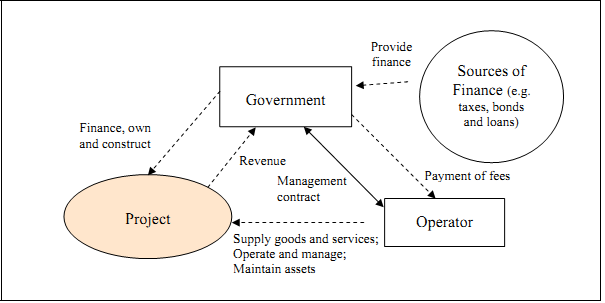
Figure 4. Management contract
The main pros and cons of this model include the following:
| Pros: • Can be implemented in a short time • Least complex of all the broad categories of PPPs • In some countries, politically and socially more acceptable for certain projects (such as water and strategic projects like ports and | Pros and cons |
|
|
Cons:
• Efficiency gains may be limited and little incentive for the private sector to invest
• Almost all risks are borne by the public sector
• Applicable mainly to existing infrastructure assets
There are several variants under the management contract including:
| • Supply or service contract • Maintenance management • Operational management These variants are explained hereafter. | Variants of management contract |
|
|
________________________________________________________________________
___
14
For example, the initial management contract for Port Klang in Malaysia with a foreign company was only for three years. The main purpose was to set-up the system so that eventually a local company could take over for a longer period. See more on this project in a later section in this primer.
15 In figure 2 and all other subsequent figures only the main flows between different entities are shown to illustrate the typical arrangements.