Cash flow analysis
| It is important to analyze a project’s cash flow as available cash is used to service any debt obligations. The analysis is done through the development of a cash flow model. Once the financial model for a project is developed, the implications of alternative financial structures and effects of changes in other parameter values on cash flow can be analyzed. Figure 10 shows a typical cash flow situation. The following are the critical components of a cash flow model: | Why cash flow analysis is important |
|
| |
| • Capital investment • Financial structure • Terminal cash flow • Discount rate • Assumptions on parameter values |
| The capital investment is the cost of developing a project, regardless of funding sources. Typical components of capital investment cost are: land and site development costs, buildings and all civil works, plant and machinery, and technical, engineering and other professional service fees. | Capital investment |
|
|
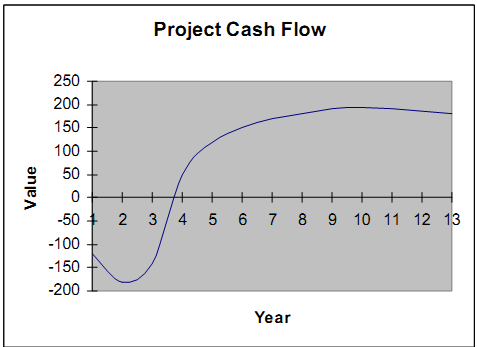
Figure 10. Typical project cash flow situation
| Alternative financial structures are considered to calculate the average cost of capital. Once the cost of capital is known, cash flows can be calculated for the following situations: | Cash flow at different points to meet obligations |
|
| |
| i) after meeting the operating expenses ii) after paying interest and keeping provisions for depreciation but before paying tax iii) after payment of tax, and iv) net flow. |
| Box 7: How subordinate debt helps in debt financing The revenue available for debt service is used first to meet the senior claims. If revenue is still available it is then used to meet the junior claims (subordinate debt and thereafter equity). A simplified example below shows how it works in reducing the burden of debt on a project.
On a combined claim (if the whole amount of loan was of the same type, i.e. senior debt), the coverage ratio is 1.17, which in most circumstances would be considered low and not qualify for cheaper credits. The coverage ratio, however, is significantly improved if the debt is divided into two parts: a senior debt and a subordinate debt. As the senior debt is only a portion of the total debt and has the first claim on all the revenues available for debt service, its coverage is increased to 1.5 and its credit quality would be enhanced. The credit quality is very important to debt financing. With a good credit rating the project may also be bond financed. As the cost of bond financing is generally lower than commercial borrowing from banks and financial institutions, bond financing can significantly enhance the financial viability of a project. The availability of subordinate debt helps in reducing the risk to senior debt lenders and allows the project sponsor to borrow at lower interest rates. The subordinate debt provider, however, absorbs a share of the risk if revenues fall short of debt service requirements. Because of this feature of subordinate debt in reducing the monetary cost of debt, some governments provide loans to implementing agencies (under public credit assistance programmes) to improve the credit quality of senior debt. It lowers the risk to lenders and helps the implementing agency to obtain loans at a lower interest rate reducing the debt burden on the project. | |||||||||||||
| Source: | Based on an example given in Federal Highway Administration, US Department of Transportation (undated). Innovative Finance Primer, Publication Number FHWA-AD-02-004, available at http://www.fhwa.dot.gov/innovativeFinance/ifp/ifprimer.pdf | ||||||||||||
| The terminal cash flow is the cash that is generated from the sale or transfer of assets upon termination or liquidation of the PPP contract tenure. In the case of a PPP project, the residual or transfer price is generally negotiated and included in the contract agreement. | Terminal cash |
|
|
| The discount rate is the rate that is used to calculate the present value of future cash flows. It is often the weighted average cost of capital for the project from different sources. | Discount rate |
|
|
In order to calculate the future cash flows it is also necessary to make assumptions of important parameter values over the project’s life. The main parameters for which values need to be assumed include: interest and inflation rates, pricing mechanism, demand for the goods and services produced by the project, construction time, debt repayment method, depreciation schedule, tax structure, and physical and technological life of assets.