A. Contract Agreements
| Contract agreements of a project between the contracting authority in government and the concessionaire/private project company may be contained in a single document or may consists of more than one separate document. It is difficult to generalize all possible contents of such agreements as they vary due to difference in legal and regulatory provisions from one country to another, type of PPP model and the nature of involvement of the public sector, implementation arrangements (including financial matters), operational, and various sector specific resource utilisation, technological and other matters. There are, however, certain key elements that are expected to be covered in most contract agreements. | Main contents of a contract agreement |
|
|
The main issues that are generally covered in a PPP contract may include the following:
• Definitions and interpretations
• Tenure of contract, end of term arrangements and access rights to the project site
• Obligations of parties to the agreement (the private party, the contract awarding agency and the government)
• Project, project site, and ownership of land and other assets
• Design, construction, commissioning, operation and maintenance of the facility
• Engagement of subcontractors
• Handover of project facility
• Performance requirements
• Payment and other financial matters (including tariff, fees and their collection and appropriation; price review and adjustments; and penalties for failure to meet performance requirements)
• Tariff, fees, levy and their collection and appropriation
• Insurance
• Waste treatment and disposal
• Independent engineer
• Independent auditor
• Applicable law and dispute resolution
• Change in law
• Liability and indemnity
• Force Majeure
• Termination of contract
• Events of default and termination
• Contract compliance and management (including monitoring and review, data collection, compilation and reporting)
• Redressal of public grievances
• Representations and warranties, disclaimer
• Substitution Agreement
| The preparation of contract documents can be a major administrative task in PPP development and may also require a considerable amount of time. The availability of standardized contract documents or model contract agreements with the provisions of model clauses can be of great help in this respect. It helps considerably in streamlining the administrative process by reducing the time in preparing such documents and getting them cleared by the concerned government agencies. Model concession/contract agreements or MCAs also reduce the cost of legal fees in preparing contract documents. Considering its advantages many governments have developed MCAs for their PPP programmes. The MCAs prepared by the National Highway Authority in India for their national highway development programme are examples of such model agreements.44 | Model concession agreement |
|
|
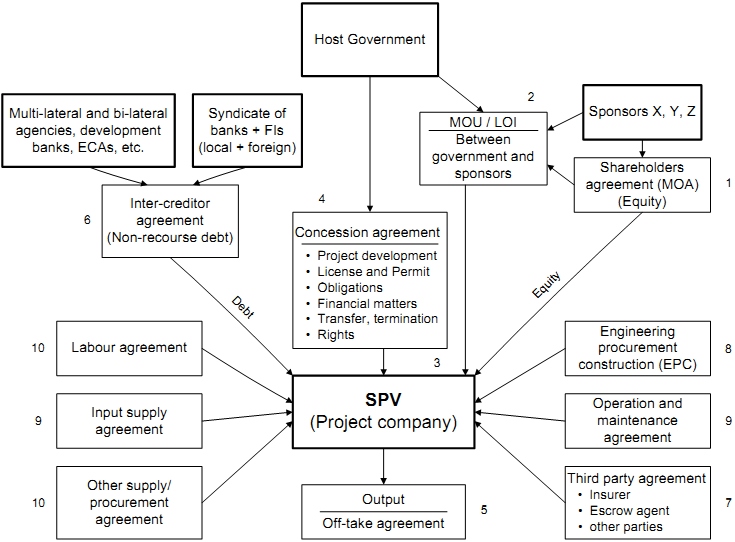
Figure 12. Agreements in a typical PPP arrangement
The body of the contract agreement is generally divided in several sections or chapters, each on a specific issue. There may be one or more annexes or schedules attached to the main body of the agreement. These annexes or schedules provide more details on some specific matters, for example the technical and performance specifications for the project. The generally common key sections of an agreement and the nature of their contents are briefly mentioned next.
The preamble of the agreement. This section identifies the parties in agreement, purpose of the agreement, context and reference to legal empowerment of the authority to execute the agreement, objectives and description of the project (generally more elaborate scope of the project are mentioned in a schedule attached to the main agreement), language and number of original copies of the agreement, date of effect, the date and place of agreement, and other related matters.
Definitions and interpretations. This section provides operational definitions and interpretation of terms (such as, accounting year, agency, authority, book value, concession, contractor, financial closure, good industry practice, minister, terminal, etc.) used in the contract document that require clear understanding. It may also define what would prevail if any discrepancies or ambiguities in the text of the agreement are observed.
Tenure of contract/concession. With other relevant items, this section outlines authorisation of activities granted to the concessionaire or the project company; rights, privileges and obligations of the concessionaire/project company; and concession/contract period. It may also mention what would have to be done by the private company at the end of the contract period
Project, project site, and ownership of land and assets. The major items in this section include location of the project site, rights, title and use of the project site, handover of the project site, possession of the site, maintenance of the site, and applicable licences and permits that the private company need to collect from concerned authorities. It may also mention if the contracting agency would have any role in securing those licences and permits.
Concessionaire’s/private company’s obligations. This section deals with matters on general obligations; shareholding arrangement; financing arrangement, financial close and refinancing; use of insurance proceeds; uninsurable risks; information disclosure and public information; and performance security. Obligations in respect of sectoral issues (for example, providing interconnection to services provided by other operators), and various reporting requirements to regulatory bodies may also be included in this section or in a separate section.
Implementing agency’s obligations. It provides general obligations and specific obligations of the contracting agency. These may include, for example, establishment of a tariff review commission, government incentives that may be applicable, handing over the project site and other areas in which the concessionaire/project company may expect support from the government and the conditions of such support. The obligations of the government, if any, may be considered in a separate section.
Design, construction, operation and maintenance of facility. This section may include provisions related to the design and preparation of drawings, approval of architectural and engineering design and drawings, review and approval of design and drawings, project construction, start and completion, consequences of early and late completion, monitoring and supervision of construction, testing and commissioning, operation and maintenance, temporary closure for repair and maintenance, incidence management, network connectivity and access to facility by other operators/agencies, material breach of operation and maintenance, performance measures (quality and quantity of project outputs), performance monitoring, information disclosure, below performance, insurance, operation period, etc.
Engagement of sub-contractors. The purpose, general rules, applicable areas, obligations of the private company in engaging sub-contractors are mentioned in this section.
Handover of project facility. Time, obligations of concessionaire, defect liability, rights of agency, procedure of handover, and valid discharge are the major points in this section.
Performance requirements. This covers the details of service delivery and other technical, quality and safety standards 45 ; availability of contracted services and procedures for variations of service scope. Normally, these are included in a separate schedule annexed to the main agreement.
Change of scope. This section defines the necessity of change, admissible changes and the defined procedure for making such changes.
Payments and financial matters. This section may consider the provision of types and period of payments (including mode of payment, valid discharge, dates of payment etc); procedure for payment; calculation of the amount of payment; payment adjustment; bonus and reduction in payment; security; sinking funds; VAT and other taxes; performance security; supervision charges of the implementing authority; and monitoring expenses.
Tariff, fees, levy and their collection and appropriation. The implementing agency’s rights, concessionaire’s obligation, tariff structure and amount, exemption and discrimination, subsidization/cross-subsidization, reviewing of tariff, tariff adjustment, cost of tariff review, fees and levy, integration of fees and tariff with other relevant operators, appropriation, revision of fees, collection and payment/transfer mechanism are included in this section. It may also include accounting standards, information on cost of operation, tariff review process and mechanism.
Insurance. This section specifies the types of insurance the private party (project company/concessionaire) in contract is required to have, the proof of such insurance covers, and application of insurance proceeds.
Waste treatment and disposal. The coverage of this section may include types of waste covered and their sources; methods of collection, transportation, treatment and final disposal (solid and liquid); physical, chemical and biological characteristics of the wastes at final disposal; and recycling of treated waste water. The details of technical standards on treatment and disposal can be considered in a separate annex or schedule.
Force majeure. This section considers events (political and non-political), obligation of parties, allocation of costs, compensation to concessionaire, termination of contract due to force majeure and payments due to such termination.
Termination of contract. The contents include the possibility of renewal, the transition arrangements when a new operator takes over, the basis for calculating compensation for assets not fully amortized or depreciated and related matters.
Events of default and termination. The matters of consideration include concessionaire event of default, agency event of default, termination due to concessionaires or agency events of default, obligations and rights of parties, termination procedure and payments and claim on assets.
Independent engineer. This section specifies the eligibility and general qualifications and broad terms of reference for such parties, procedure for the appointments, payment, replacement and eligibility for reappointment. Payment to independent engineer and other third parties may also be included in this chapter.
Independent auditor. General requirements and eligibility, procedure of appointment, obligations of the auditor and payment of fees are specified in this section.
Applicable law and dispute resolution. The applicable laws, methods of dispute resolution to be used (conciliation, arbitration, etc.) and their procedure, obligations and rights of parties are specified in this section.
Change in law. The definition of meaning by change in law, assessment of effect on concessionaire, compensation to concessionaire, obligation of concessionaire and other related matters can be covered in this section.
Liability and indemnity. Indemnity provided by the concessionaire to the government, implementing agency, and other government agencies; and indemnity provided by the implementing agency/government are covered in this section.
Representations and warranties, disclaimer. Representations and warranties of the concessionaire and the implementing agency, obligations to notify any change to the other party are covered in this section.
Contract compliance and management. This section outlines the establishment of a contract management set up including line of communication between the private party and the implementing agency, clear administrative procedures for communication on different matters, data collection, compilation and reporting requirements.
Redressal of public grievances. This section specifies how members of public can make complaints, marinating a register of public complaints and how the private party is to address those complaints.
Miscellaneous. This section considers amendment to agreement, governing laws and jurisdiction, waiver, counterparts, etc.
Schedules and annexes. Description of each schedules on various items (I, II III, etc.) as referred to in the main text are mentioned in this section.
Substitution Agreement. This is a provision for a separate agreement between the implementing agency and the senior lenders for securing their interests through assignment, transfer and substitution of the concession to a nominated company under certain defined conditions. Generally this contained in a separate schedule annexed to the main agreement.
___________________________________________________________________________
44 Available at <http://www.nhai.org/concessionagreement.htm>.
45 As the focus of a PPP project should be on delivering specified amount of services at defined levels. The details of performance requirements in a contract document are very important.