2. A Strategic Framework for Municipal Capacity Building

This chapter presents a strategy to develop the capacity of municipalities to understand, formulate and implement public-private partnerships (PPPs) focused on improving services for the poor. This strategy implicitly covers the 'what', 'why' and 'who' of partnerships in the context of poverty, municipal government and outside influences; it also emphasises the importance of linking partnerships with existing urban governance and poverty reduction frameworks. Aspects concerning the poor are inherent in all the components; they are overlaid with a concern for those existing and potential dimensions of partnerships that affect the poor. Underpinning the partnership with receptive, skilled and effective public sector partners is highlighted as being a key aspect of the framework. This chapter provides a framework for capacity building and provides the structure for the remainder of the sourcebook.
Irrespective of location, a strategy for building capacity in private sector participation at the local level of government should aim to rationalise and structure the primary elements and issues into a coherent and comprehensive framework. Such a framework and its inherent divisions can only ever provide a guide, and can only ever represent one approach to the problem. The political and economic context and the institutional, social and cultural norms at the local level will invariably result in changing emphases and highlight specific problems. This framework is therefore presented with the intention that consideration should be given to each and every context as an integral part of its application.
Box 3.1 provides a diagram illustrating the strategic framework for capacity building.
This sourcebook discusses a range of issues and provides a range of illustrations of PPPs. It is aimed at broadening the debate and raising levels of awareness about PPPs - especially as they relate to the poor - through municipal capacity building initiatives. These issues and illustrations are many and varied. No individual municipality is expected to pick up this reference book and implement its contents. Rather, the book it intended to provoke consideration and dialogue about what is possible and relevant in any specific context. The primary elements of the strategic framework are signposted through the repetition of the key diagram, locating each chapter in relation to the strategy and book as a whole.
The illustrative material placed in boxes is intended to be detailed rather than cursory. Each box tells a story of an experience. These boxes can be read individually, by chapter, or by case, with the intention of bringing reality to partnership concepts.

Part 1 considers what 'focusing a partnership' means. In order to consider PPPs in relation to the urban poor, a municipality needs first to clarify their objectives of improving services and the benefits that a partnership involving the private sector might bring, to consider the way the partnership will be developed and function as a part of city governance, and to consider the mechanisms that will ensure that the partnership contributes to poverty reduction.
□ Meeting municipal objectives through partnerships |
In order to focus a partnership effectively, it is necessary to establish whether the partnership approach is appropriate for the purpose of meeting the intended municipal objectives. A fundamental element of capacity building for PPPs, therefore, is the development of an understanding of municipal problems and objectives, and the consideration of whether a partnership approach to service delivery has the potential to meet these objectives. The chapter discusses the fundamental question asked by many officials - why involve the private sector in municipal service delivery? - and considers the benefits and the key issues that municipalities should look out for. It aims to provide a basis for municipal action that is then filled out by each subsequent element of the framework.
□ Locating and linking partnerships in urban governance and management |
Current best practice provides a range of reforms intended to result in the more effective governance and management of cities. These reforms include, for instance, democratic processes, stakeholder participation, financial sustainability and cost recovery, corporatisation, human resource development, accountability and transparency, and so on. The process of developing private sector participation in urban infrastructure and services both influences and is influenced by this dynamic process of reform. Partnerships are not isolated 'projects' but primary aspects of shifting methods of urban governance and management. This element of the framework is introduced to locate the concept of PPPs within a broader understanding of how cities in developing countries are run, to consider where private sector participation fits in this process, and to establish the key linkages between sectors and municipal functions. One of the primary aspects of this discussion concerns the sectoral approach to private sector participation in the context of the multisectoral obligations of municipalities. Few cities have developed an integrated approach to partnerships that recognises the existence of other partnerships or the potential impacts of partnership development on other sectors.
□ Contributing to poverty reduction |
In developing countries a majority of the population may live below the poverty line. One of the fundamental issues affecting decision-making in the preparation, design and implementation stages of a public-private partnership concerns the way in which the partnership aligns with and contributes to poverty-reduction initiatives. Unlike other discussions on PPPs and the poor, which start with the contractual mechanisms of PPPs such as tariff design or expansion mandates, the development of a focused partnership framework starts with the needs of the poor and the lessons of decades of poverty-reduction initiatives. Evidence from poverty reduction and sustainable livelihood approaches points towards a number of factors as being critical to sustainable improvements in the quality of life for the poor. This element of the framework promotes understanding of the implications of these lessons, and provides some basic steps for municipalities to follow to ensure that the partnership contributes, as far as is possible, to poverty reduction.
Box 2.1 Focusing Public-Private Partnerships on the Poor |
A Strategic Framework for Building Municipal Capacity |
|
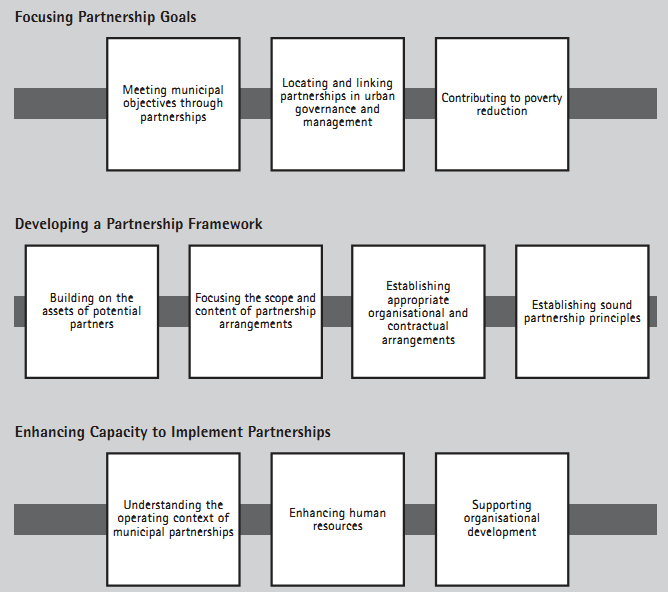

Part 2 is concerned with the nature of partnership arrangements. It considers these in terms of the actors that might be involved in the arrangement, the content of the arrangement, the existing vehicles for putting the arrangement in place, and the fundamental parameters underlying an effective partnership.
□ Building on the assets of potential partners |
Typically, established PPPs involve only public and private partners, and treat communities as customers or 'end-users'. In the case of water and sanitation at the local level, this generally means that the partnership is bilateral, comprising the municipality (or perhaps the water and sanitation authority) and a large-scale private operator able to bring skills and perhaps investment to the service in question. Yet experience over the last decade clearly shows that involving a range of interested stakeholders and creating an inclusive, transparent process can result in more focused partnerships that are more likely to meet their goals. If partnerships are to develop with an effective focus on the needs of the poor, community- based organisations (CBOs) and NGOs are both important players in the partnership arrangement, and mechanisms need to be developed to formalise, legitimise and/or recognise their role. Involving poor communities in environmental upgrading initiatives provides a solid foundation for the effort, underpinning cost recovery and promoting long-term sustainability. NGOs are often important entry points to poor communities, and they provide key skills in capacity building, hygiene promotion and awareness building; at times, they act as effective mediators between operators and consumers. Other stakeholders are the existing providers of urban services (such as rag-pickers and water-sellers), who may be severed from their incomes by formal changes to delivery mechanisms, and who also offer the capacity to fill gaps for the poor. Donors and external consultants promote and/or underpin the private sector participation (PSP) process in developing contexts. This element of the strategy presents the characteristics of key actors, their potential roles and responsibilities, and the nature of relationships that form or can be formed between these partners - from the early stages of consultation and planning (between the municipality and the community) to the partnership development and implementation stage. This is the 'who' of the partnership framework.
□ Focusing the scope and content of partnership arrangements |
The 'what' of the partnership framework is described by defining the scope and content of the arrangement. This element of the strategy focuses on enhancing the understanding of key aspects of partnerships focused on the poor. It responds to possible municipal objectives such as physical improvements, social equity, capital investment, economic efficiency and capacity building. It thus includes a wide range of issues that together make up the content of the arrangement: physical issues such as service coverage, options and performance standards; social aspects such as community participation, equity, affordability, choice, payment mechanisms, gender marginalisation and integrated responses; political aspects such as worker re-employment and the impacts on informal services providers; financial and economic aspects such as risk management, financial incentives and cost recovery; and institutional aspects that need to be considered in the creation of a partnership framework that builds capacity for more effective partnerships and more effective institutions. The purpose of presenting these issues as a menu of ingredients in a partnership framework is to encourage municipalities to think through the composition of a partnership in relation to their objectives.
□ Establishing appropriate organisational and contractual arrangements |
The key aspects of the partnership framework (the scope and content, the potential actors) need to be structured into an appropriate organisational and contractual arrangement. This element of the framework explores possible partnership structures and describes legal instruments (their characteristics and how they may influence the partnership focus). This includes a discussion of the current range of contract options utilised - from service and management contracts to affermage/lease,1 franchise, concession and build-operate-transfer forms of contract. In addition, it provides a discussion on organisational relationships with small-scale providers and NGOs and considers where the municipality sits in relation to a utility or a joint venture.
□ Establishing sound partnership principles |
This element of the partnership framework proposes that fundamental principles need to be adopted at the outset, and included in the strategic approach for successful and sustainable preparation and implementation of PPPs. These include the principles of transparency, accountability, specificity, legitimacy, flexibility, equity, participation, clarity, predictability and empowerment. It discusses the importance of these principles and elaborates on their meaning in the context of municipal-private sector partnerships.

Part 3 is focused on the capacity required at the municipal level to bring all this about. In order for the municipality to take forward partnerships focused on the poor, it is necessary to not only consider what the ingredients are and who the players are, but what kind of capacity will lead them there. In essence, this means understanding the key steps in the process of initiating, developing and implementing a partnership. This includes: developing a better understanding of the factors that affect the capacity of the municipality to act; enhancing human resources; and supporting organisational and managerial change.
□ Understanding the operating context |
The partnership framework does not exist in a vacuum. Like most municipal endeavours, it exists within an operating environment that both influences and is influenced by municipal capacity and action. The primary part of this is the regulatory environment: a key factor in the development of PPPs is the legislative and regulatory structure (whether it is found at the national or provincial level). This has an over-riding influence on municipal capacity and action in relation to PPPs. In addition to the regulatory framework, the political and economic climate will have a significant impact on the possibilities of any partnership, while the policy and administrative context (and the risk of blockages and interference, for instance) will influence how and what can be achieved. Given that, in most contexts, government structures are hierarchical, the operating context is determined by the degree of influence of higher levels of government and the overall role of the municipality in the administrative structure. The strategy for building capacity in municipal-level PPPs highlights the importance of understanding the constraints and limitations of the operating context, to ensure that goals are achievable, viable and sustainable.
□ Enhancing human resources |
Human resource development is an inevitable and critical component of the strategy to create service partnerships. From the perspective of a resource-deficient municipality, this chapter considers the numerous skill sets that are needed to create a new form of pro-poor partnership, whether they are found in-house or are bought in. Understanding the range of skills required is defined as a competency in itself. Most municipalities, even those in which some resources are available, will lack the skills necessary to meet the new challenge of partnerships involving the private sector and poor communities. This discussion, therefore, presents the skills needed to achieve a partnership focused on the poor. While human resource development will vary significantly along with the arrangement that is envisaged and the existing capacities of the municipality, new competencies are required for PPPs, and municipalities need to be aware of the extent and diversity of these skills. This will enable decision-makers to decide what expertise is needed in-house, and which skills are best bought in from the outside. A particular focus of this chapter is on the skill sets needed to ensure that partnerships address the needs of the poor and converge with other poverty-reduction programmes, and the skills needed for partnering (municipalities are often accused by large and small-scale private enterprises of not knowing how to be partners). This discussion is summarised in a skills framework and is supplemented by a description of methodologies for developing and sustaining skills within the municipality.
□ Supporting organisational development |
Evidence clearly suggests that the greater the capacity of the municipality, the more effective the partnership. The partnership approach does not remove the need for a municipality to be a well-managed and well-organised institution, capable of playing its role in the management and monitoring of the service-delivery partnership. This element of the strategy focuses on the organisational capacity of the municipality. It considers the key aspects of organisational development necessary to create sustainable partnerships in the context of a heavily bureaucratic and lethargic municipal organisation. It considers organisational constraints and responses in terms of management, systems, structures and finances. It also considers municipal attitudes. Given the nature of municipalities and the scope of municipal functions in developing cities, perhaps the fundamental challenge and change required to launch effective partnerships is attitudinal. The creation of a supportive cadre of officials and politicians is a primary step in the development of municipal PPPs, and in the development of municipal capacity to create and sustain effective PPPs.
Chapter 13 presents a summary of this information in A Framework for Action.