The Service Problems of Municipalities
Municipalities in developing countries face an insurmountable task: on this, there is little disagreement. The frequently quoted levels of urban infrastructure deficiency provide ample evidence worldwide of the crises and challenges that face urban managers. However, deteriorating infrastructure and declining service delivery are just the outward signs of the crisis in urban management brought about by a range of external and internal economic, institutional, social, demographic and environmental factors. The rapid rate of urbanisation is well known to municipal managers in Latin America and Asia, and increasingly in sub-Saharan Africa. Growing urban populations place significant pressure on the existing infrastructure in core areas and create a demand for improved service delivery in underserviced marginal and peri-urban areas. Existing infrastructure is often past its prime. Declining economic growth in many parts of the world has constrained investment and finance. A chronic deficiency in municipal resources - brought about through mismanagement, inadequate finances or overly-bureaucratic and ineffectual management - has led to overloaded and unmaintained systems. The impact of each factor varies according to the context, but all contribute to the more visible problem of deteriorating services and infrastructure, and are an intrinsic part of the municipal service problem.2
From the perspective of the poor, however, the urban problem is not only that services are inadequate, but also that the existing processes of resource allocation have often resulted in the marginalisation of the poor from the benefits of the existing infrastructure and services. This inherent political bias in the decision-making over service provision will not be removed by an increase in private capital investment if that investment is not accompanied by policies and mandates which ensure that the poor benefit.
The description of municipal service problems can be quite complex and the perception of service problems can vary between stakeholders. Within basic service delivery (such as water supply, sanitation and solid waste services), various sector-specific factors, along with demand and supply constraints, often change the nature of the problem. Understanding the complexity of the problem is thus a keystone that leads to clarity in the definition of objectives and greater understanding of the benefits of the private sector. Yet many municipalities have a limited capacity for analysing and articulating physical and institutional problems, and many overlook the ways in which users experience service problems. This lack of skill ultimately affects decision-making and the development of appropriate solutions.
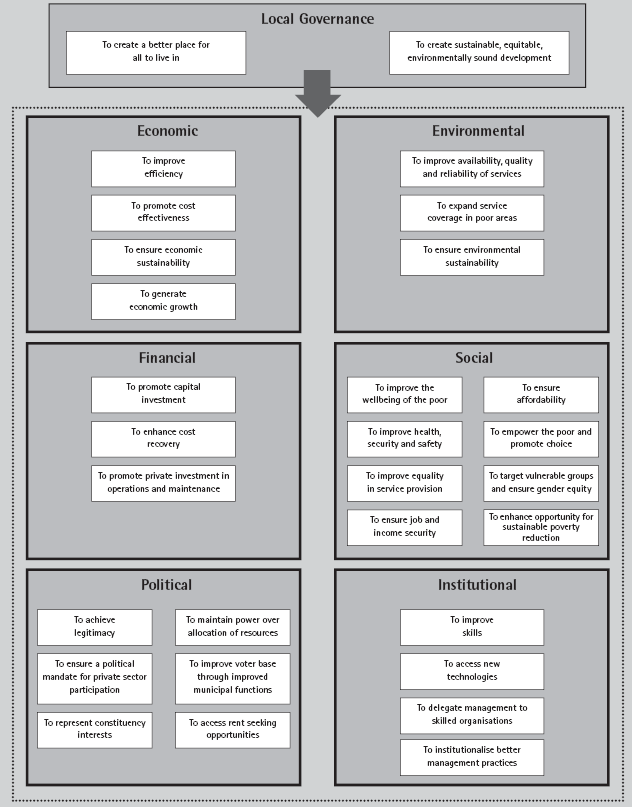
| Box 3.1 A Municipal Objectives Framework |
|
|