Establishing a Sound Basis for a Poverty-focused Partnership
The following section describes some of the key actions municipalities can take to develop partnerships that contribute to poverty reduction goals. The lessons discussed below, while not comprehensive, point towards the types of changes that the PPP must embrace if future solutions are to bring about maximum benefit to poor urban dwellers. The lessons of participation, capacity building, integration, variability and diversity, gender marginalisation and the role of existing service providers are useful examples of service delivery focused on the poor. This chapter does not stand alone, however; key poverty-related issues are detailed in each of the chapters that follow.
Box 5.2 Differing Experiences of Poverty
A South-East Asian Profile Links to Box 7.5
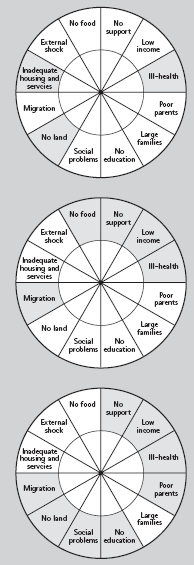
The following household stories illustrate the differing experiences of urban poverty in Vientiane Laos. The stories are supplemented by poverty wheels that portray the key cause-effect parameters. A simple comparison in the wheels illustrates both the different experiences and recurring themes of poverty.
| Insecure tenants Madame A is around 30 years old. She is married with two children and is pregnant. Three years ago she and her family were evicted from a house in Sihom and moved to Thong Khankham. There they occupy a timber and corrugated- iron-clad house on stilts. Their rent is around 10,000 kip.* The house was empty before they moved in as it was considered uninhabitable. It is the innermost house in this area, on the lowest, most waterlogged ground. the house sits in a mix of flood-waters, sewage and solid waste. To reach the house the family picks its way along 10 metres of rotting timber. The insanitary and damp environmental conditions around the house cause Madame A to worry for the health of her children. Her eldest son had malaria recently. They continue to live there because it is cheap, they have no jobs and cannot afford anything else. An abandoned migrant Madame M is 62 years old. She migrated from China in 1960 when she was 15 years old, and her young baby died during the journey. When she settled in Laos she was given Laotian nationality. Her husband has left her and is remarried. Madame M lives by herself in a tiny hut. She is alone and homesick, and would like to return to China. Her monthly income is 60,000 kip. She collects and eats vegetables that grow in the neighbourhood, and sometimes buys rice and fish. She used to sell noodle soup, but people did not pay. Her income now comes mainly from cleaning and washing for other households. Her hut has a sheet-metal roof, and as it is not raised, during the wet season the hut is constantly flooded. The pathway to her house is narrow and very muddy. She does not have an electricity or water connection. Instead she uses a candle for light and buys water from neighbours. Her house is behind that of a rich family who constantly pressurise her to move. She says she settled there first and will never move. She has nowhere else to go. Although she has been severely sick several times, she does not visit the doctor. When she has nothing to eat, a neighbour or the village authority provides her with cash or rice. She never borrows money because she knows she can not pay it back. Madame M once saved 30,000 kip but lost it in the national lottery. She believes her poverty is caused by her lack of ideas about how to make what is needed for her daily life; she also believes that she inherited it from her forefathers. A beggar and drug user Madame X is from an ethnic minority in the rural areas of Laos. Her husband fled to France and she has been alone for 30 years. She lived in several places in Vientiane and then moved to Nong Chan; she will soon have to move again. When she first came to the city she sold herbal medicine, and sewed cement bags together for rice farmers to use in rice harvesting and processing. She is illiterate; she worked on a farm and never went to school. She has no family to rely on and now she begs in the market. She gets around 13,000 kip per day. She smokes heroin to relieve her pain. * kip = Lao monetary unit |
| Source: Adapted from Plummer, 2000b |