The Sustainable Livelihoods Approach
A 'livelihood' comprises the capabilities, assets (including both material and social resources) and activities required for a means of living. A livelihood is sustainable when it can cope with and recover from stresses and shocks and maintains or enhances its capabilities and assets both now and in the future, while not undermining the natural resource base.8
During the 1990s, a significant number of the lessons described in this chapter about poverty responses were acknowledged and consolidated into policy-making through the development of a comprehensive approach to poverty reduction, referred to as the sustainable livelihoods (SL) approach.9 In essence, the SL approach aims to provide a cohesive methodology for poverty reduction that focuses on the livelihoods and vulnerability of the poor. It builds on and resembles, but simultaneously challenges, many previous development approaches. At its core is the understanding that people must be placed at the centre of any development initiative.10
The SL approach includes and promotes the development of PPPs in service delivery. It highlights the importance of transforming structures, and specifically emphasises the need for a range of governmental, non-governmental and private actors to work together in the pursuit of poverty reduction. This is based on the lesson that all too frequently, existing (and transforming) structures do not always work to the benefit of the poor,11 and that the processes that frame the livelihoods of the poor systematically restrict them and their opportunities for advancement.12 In close association, the SL framework promotes the transformation of processes, which result in effective structures. This is to be established and sustained by the development of enabling frameworks, incentive systems, regulatory environments, and formal processes that encourage private sector activity; and by considering the informal practices and power relations that frame relationships between the poor and other actors.
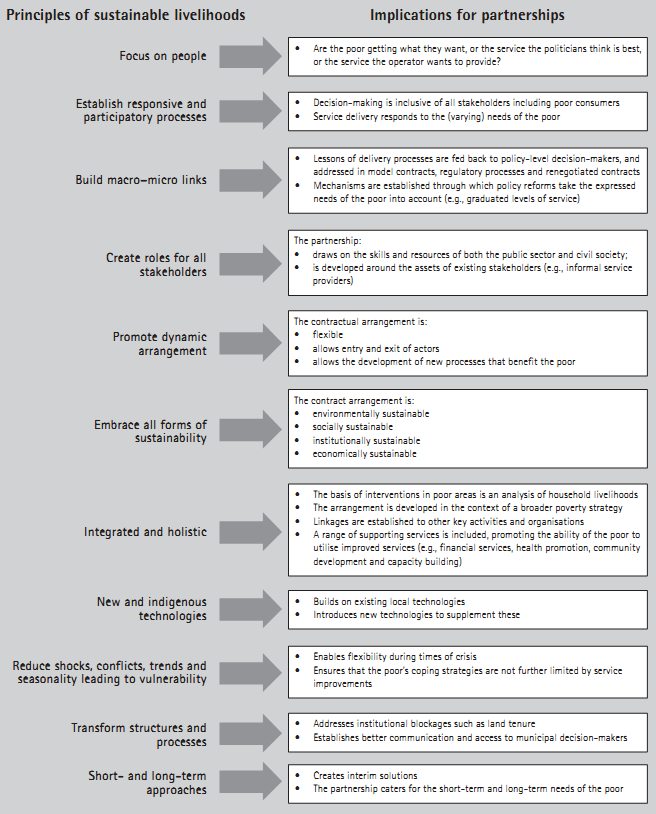
The purpose of introducing the SL framework here is to consider it as a mechanism through which municipalities and other actors can bring a poverty focus to a service partnership. The SL framework, its principles and core concepts provide a useful starting point for the creation and re-creation of partnerships that aim to contribute to poverty reduction. Because it provides an analytical framework for integrating ideas and methods, it is an ideal tool for municipalities to use in formulating a structured and systematic approach to poverty reduction in which people, not outputs, are the focal points. Municipalities and other actors can use it to both plan new partnerships that work to the benefit of the poor, and to review existing partnership arrangements. These principles and their implications on service partnerships are illustrated in Box 5.5.
Box 5.5 Incorporating the Principles of Sustainable Livelihoods in PPPs |
|