□ The nature and diversity of the private sector
The term 'private sector' can be used to mean many things. In discussions of PPPs, the term 'private sector' often implicitly refers to multinational companies - large, profit-oriented organisations that operate across borders and report to shareholders. However, the development of private sector involvement in poverty-focused service delivery can and should denote a far broader vision of the private sector - one that includes a range of actors delivering services. The primary characteristic of the private sector is not size, scope or capacity. The key distinguishing characteristic is that individuals, organisations, businesses or enterprises act in the pursuit of profit.
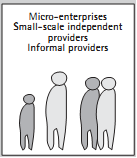
With regard to the delivery of municipal services, it is useful to consider three different types of enterprise: international, national and small-scale (formal or informal) local enterprise. Although all of these types involve the pursuit of profit, their scales of operations are almost always associated with the distinct competencies and benefits that they bring to a partnership. Within each typology there is undoubtedly further diversity; the categories are not discrete but operate as a continuum, and PPPs may include one or all of these categories in a collaborative effort. The categories are summarised in Box 6.4.
The term 'private sector', in relation to municipal service delivery, therefore covers a vast range of profit-making organisations - large and small, formal and informal, in a range of sectors. One end of the private sector spectrum is represented by large international water companies such as Ondeo-Lyonnaise des Eaux, Vivendi and Thames Water. The other end is represented by the water-vendor with a cart, selling water by the container. In the solid waste sector, the national operators with compactors and large-scale landfill and recycling facilities are contrasted with the small-scale rag-picking cooperatives or itinerant waste-buyers, whose self-employed recycling activities are the basis of their livelihoods. In between these extremes lies a set of profit-making enterprises/organisations whose capacities and interests are all potentially relevant to the different types of water and waste services.
| Box 6.4 Disaggregating the Private Sector | |||
|
| Formal/large |
| Informal/small scale |
|
|
|
|
|
| Competencies | • Technical expertise • Financial resources • Management expertise | • Technical expertise • Management expertise • National knowledge • Local legitimacy | • Local knowledge • Innovation with local resources |
| Benefits | • Inflow of finances, skills and technologies • Managerial experience • Innovation | • Building national capacity and expertise • Local networks • Government links | • Generating local socio-economic development impact • Creating community ownership • Powerful development impact if properly engaged |
| Market interests | • Large-scale projects • Market entry • Limited risk | • Medium-scale projects • Secondary cities • Working in consortia | • Filling gaps in service supply • Flexible commercial opportunities requiring limited investment • Relatively high risk, but small size • Poor households • Inaccessible, marginal areas • Peri-urban areas |
|
| • Water supply | • Solid waste • Water supply in consortia | • Tertiary level: water supply, sanitation services, and solid waste collection |
| Political issues | • (Generally) outside the web of local politics: might be less corruptible | • Generally very dependent upon local politics and individuals | • Outside the political system and therefore less valued and less influential |
| Other issues | • Driven simply by contracts • Profits taken out of country • Inevitably promote an international culture national values | • Driven by national pride • Profits more likely to stay in country • Culturally more likely to support | • Driven by need for personal income • Profits usually retained in community • More likely to meet very poor's requirements |