□ Comparing assets of potential actors
The potential actors in service partnerships (described above) all fit within one of the three organisational sectors: the public sector, the private sector and civil society.23 In order to maximise the potential of a partnership, the municipality must aim to develop an understanding of the comparative attributes of these potential partners. The framework illustrated in Box 6.23 presents the characteristics described earlier and juxtaposes fundamental differences.24 While any specific organisation will not perfectly reflect these qualities at all times, the framework provides an analytic tool for comparing the assets of potential partners.
The comparative table sets out the characteristics and allows further consideration of the relative strengths and weaknesses of each organisational sector in relation to the poor. In a competitive environment, business is good at maximising efficiency, and civil society is particularly good at working with poor communities striving for equity. These characteristics arise from the fundamental attributes that distinguish organisations in one sector from those in another.
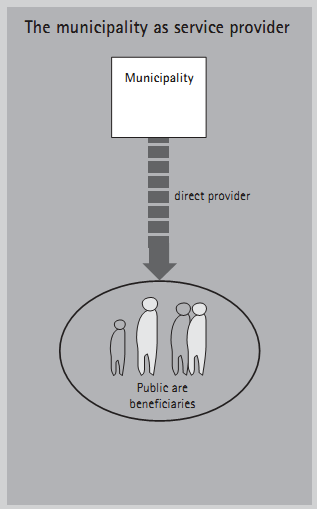
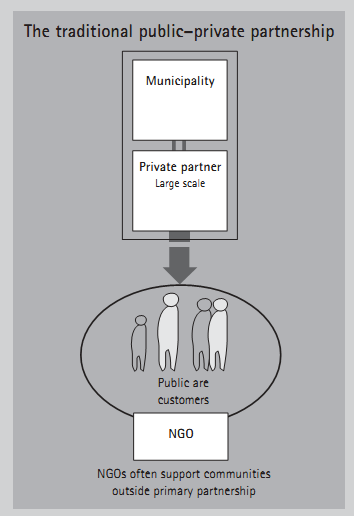
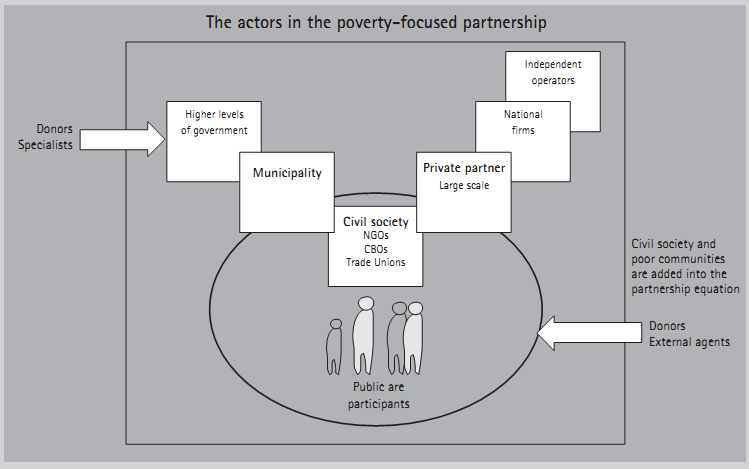
In relation to water, sanitation and solid waste services (as well as energy and telecommunications) there has been an increasing shift from an approach that only included one organisational sector - the municipality or another public agency - to one where municipalities and the private sector have joined forces in public-private organisational partnerships. In so doing, the arrangement draws on a much wider range of competencies and skills relevant for service delivery and offsetting the weaknesses inherent in each organisational sector. Yet the comparative table, and evidence from service partnerships, tell us that there are still gaps in the traditional public-private package - gaps that can be filled by drawing in the competencies of the civil society sector. Box 6.24 illustrates the development of this process and the increasing inclusion of various actors within service delivery partnerships. In the development of innovative inclusive approaches to municipal services, the key for municipalities lies in the creation of an approach that taps the strengths of each sector and offsets their inherent weakness through the allocation of roles and a decision-making structure.
| Box 6.24 Locating Partners in the Service Delivery Process | ||||
| Changing Roles and Relationships
| ||||