7 Focusing the Scope and Content of Partnership Arrangements
Janelle Plummer and Brad Gentry
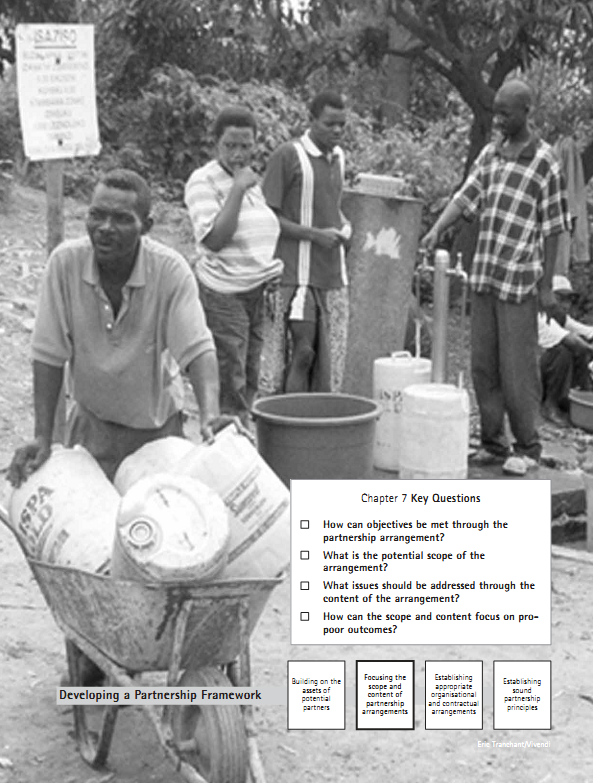
The success or failure of a municipal service partnership to focus on the poor will depend not only on the development of a well-functioning partnership team (see Chapter 6), but on the scope and content of the partnership arrangement. In the past, traditional forms of public-private partnerships (PPPs) neglected to address the needs of poor communities in the scope of work defined at the outset. While many municipalities may have been very aware of the key issues affecting service delivery to the poor, this knowledge was not applied to the partnership framework; the agenda often reflected private sector knowledge of the problem and not the knowledge of local stakeholders.
The purpose of this chapter is to promote understanding of the vast range of issues that can be included in a partnership framework focused on achieving direct benefits for the poor. In order to help municipalities to create effective and targeted partnerships, we present and discuss a menu of key elements, describe alternatives and options, and highlight the known implications of the scope and content of partnerships.
There is of course no such thing as a perfect partnership arrangement - any more than there are perfect municipal institutions - and the aim here is not to provide a set of non-negotiable elements that make up an idealised framework. Each municipality will have different problems and requirements and will emphasise different elements; each will have a different capacity to take various parts forward. For a municipality, the key goal in defining the partnership framework must be to fulfil as many of its agreed objectives as possible.
The range of potential objectives proposed in Chapter 3 therefore provides a useful structure for considering the content of a partnership framework (see Box 7.1), particularly the classification of elements into physical, social, political, economic, financial and institutional aspects. Inevitably, many elements relate to more than one objective and many are inextricably linked, but a key reason for considering the scope and content in terms of different kinds of objectives is to encourage municipalities to build partnerships that respond to their own needs and to provide a framework through which they might consider all the various dimensions of a poverty-focused partnership.
Of course, the degree to which municipalities will actually be able to achieve their goals depends on the scope of their authority and the results of their negotiations with potential partners and users. As to the scope of their authority, if national or provincial governments establish the rules for tariffs or environmental quality, then municipalities will have to operate within those limits. As to the negotiations, if the private sector firms do not believe they will profit from the partnership arrangement, or if the users do not believe the services they will receive are worth the fees they will pay, then the arrangement will falter before it begins. How these tensions play out in particular partnership arrangements varies across locations and over time and is strongly affected by initial municipal decision-making.