■ Payment to non-governmental organisations
Notwithstanding the importance of how formal private sector firms are compensated for their efforts, it is also absolutely essential that the arrangement framework addresses the compensation for other partners providing services. These may include, for instance, NGOs, CBOs and independent service providers.
NGOs involved in service partnerships need to be paid for their time and costs. One of the primary areas of conflict in those poverty-focused partnerships that have relied heavily on NGOs to work with communities is that the basic framework arrangement has not adequately addressed the issue of payment for NGO services. As the driving force of the partnership arrangement, the municipality must not only ensure that payment mechanisms are established in the local context, but come to understand the implications of those mechanisms. This is discussed in terms of partnership arrangements in Chapter 8. However in relation to payments, municipalities should recognise that many NGOs will be concerned with the following:
• The source of their funding Being paid by the private firm is generally to be avoided as it compromises the autonomy with which they can carry out their role, their standing with the communities with whom they are meant to work, and their reputation more generally in the NGO sector (see Chapter 8). Being paid by other agents (such as donors) can also be problematic, as the funding will normally be for a specific duration only.
• The way NGOs are paid for their inputs The traditional assumption that NGOs should fund their own contributions may not be as marked in PPP development, but there is still some need for municipal and private sector capacity building to understand the need for appropriate payment to NGOs. This is a key source of conflict when they are clearly aiding the private sector to improve its customer base, and while they may see this as a means of improving services for the poor, they must also cover their own costs.
• The duration of the arrangement NGOs often seek long-term rather than project-by-project agreements as they promote stability, allow NGOs to develop strategic plans, and promote capacity in the long term. These benefits need to be balanced against the exclusion of other NGOs from the partnership and the potential conflicts that may arise within their organisation.
• The profit-making aspect of the partnership NGOs may agree to be involved but an underlying concern with 'rich' private firms making profits from the poor will dominate their concern. For some NGOs, there is an inherent conflict in this situation: as NGOs they will aim to cover their own costs, but at the same time their own efforts (say, in promoting cost recovery) will lead to profit - sometimes substantial profit - for the private firm.
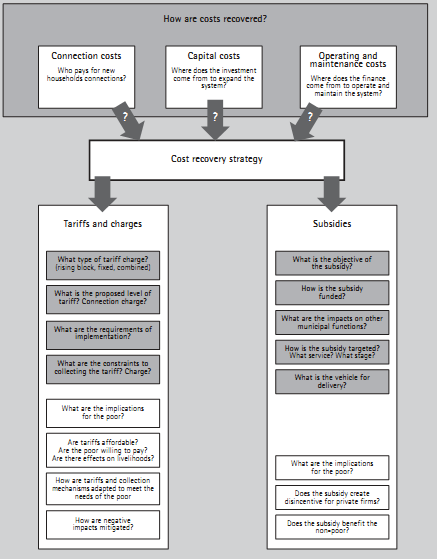
| Box 7.16 Elements of Cost Recovery |
|
|