□ Organisational capacity building
One of the primary areas of institutional development in a partnership arrangement addressing the poor is the formation and capacity building of participatory vehicles - organisations - to carry the partnership forward. These vehicles will be required at a number of levels for the effective implementation of a complex partnership arrangement with ambitious expansion and improvement goals. For simpler arrangements (such as small-scale solid waste activities), delivery vehicles are still required but may be more modest in nature.
The partnership framework must account for the formation, definition and development of these organisations in terms of financial resources (how much it will cost), human resources (who will carry out the work), and time (what the effects of the programme will be). The transparency and accountability of these vehicles will determine the degree to which the partnership meets governance objectives. Examples of potential vehicles, their capacities and the organisational development required are as follows.
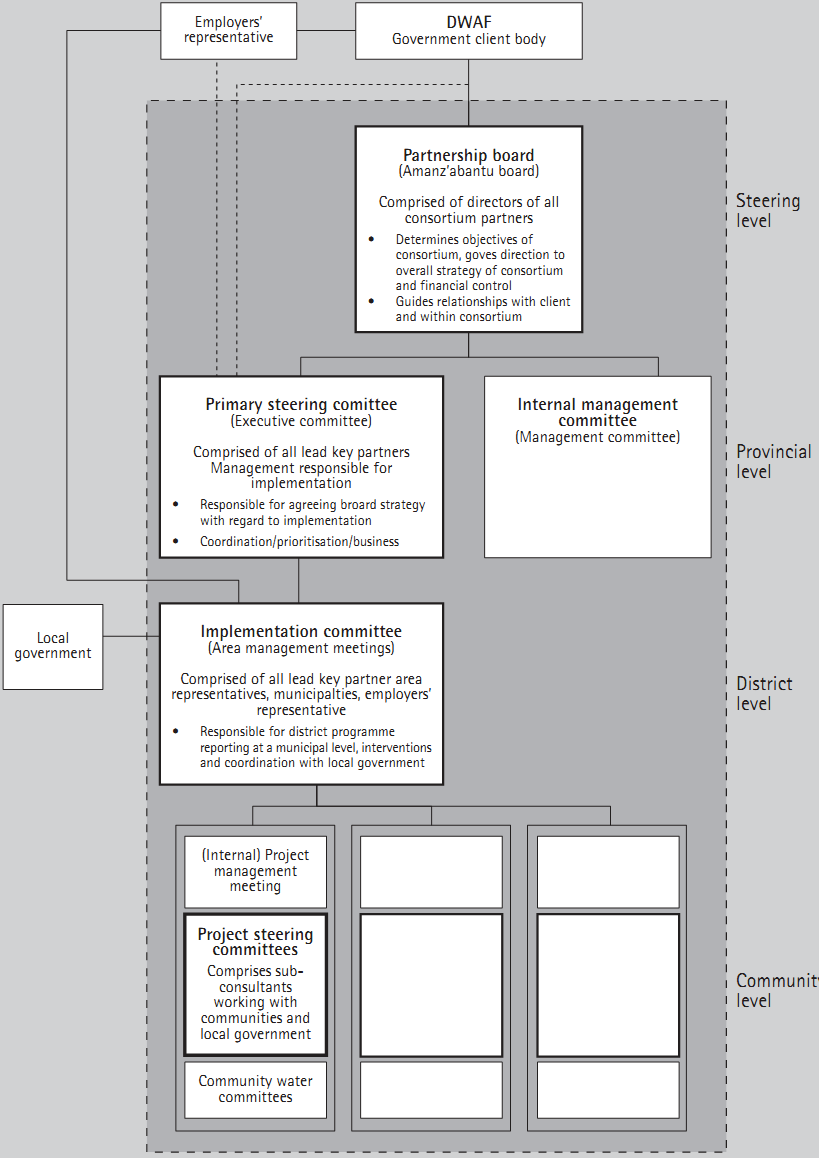
• Steering committees The development of partnership committees at the strategic level is important for determining strategic directions and resolving structural differences. The partnership arrangement should propose mechanisms for establishing overseeing committees, and mechanisms should be put in place to ensure that steering committees do not become embroiled in practical matters that detract from their capacity to deliver on strategic matters. In the decision-making structure of the South African BoTT programme, described in Box 7.21, there is a steering committee guiding the strategic direction of the consortium (the partnership board) and a steering committee working at a strategic level in relation to the entire BoTT implementation programme.
• Implementation committees The partnership framework will also need to define the key vehicle for decision- making at the operational level. Evidence suggests that, like the steering committee, the efficacy of operational committees will often be facilitated by partner champions (or hindered by non-constructive individuals). The mandate and role of the operational committee must be clearly defined, and all key stakeholders must have a place at the partnership table. A partnership cannot be focused on the poor if decision-making processes do not include appropriate stakeholders and do not give them sufficient standing. The nature of the relationships required to form effective teams must then be reflected formally through appropriate contractual arrangements.
• Community organisations The development of effective and sustainable participatory processes, and the extent of 'buy-in' from communities, will be dependent on the development of robust organisations at the community level. While some community organisations will already exist and may have been strengthened under previous development programmes, many others will be in their infancy. As discussed earlier in this chapter, skills (team-working, management, monitoring, accounting) may need to be developed and an organisational structure for community committees established. The roles to be played will determine the organisational capacity building required. Water committees, solid waste management committees etc., will need to build technical skills as well as more generic activities to perform agreed and defined roles.
The capacity building process for community organisations will need to be designed to suit the context - the objectives, the existing organisational framework, gender relations, and the capacity of both women and men to participate and be heard. In a poverty focused arrangement, following the discussion in Chapter 7, it is likely that that role will be taken on by an organisation skilled in this area of work, and not by a private sector partner whose competencies and goals are focused elsewhere. The broader urban governance agenda should provide a strategy for this process - one that is not purely related to a particular sector, but needs to be linked into other urban activities and mechanisms. The partnership framework needs to address these linkages, the organisational structure of delivery, the capacity needed to develop an effective structure, and the resources needed to build this capacity.
| Box 7.21 Vehicles for Decision-making | |
|
| |