8 Establishing Appropriate Organisational and Contractual Arrangements
Janelle Plummer and Brad Gentry

Chapter 7 has provided an overview of the primary elements making up a partnership framework focused on the poor. In practice, however, the development of the partnership framework is often determined not by a synthesis of elements appropriate to a particular context, but by the application of a predetermined contractual model. A primary concern with the existing approach to partnership development is this tendency to categorise the arrangement by contract type.1 Commonly, a focus is placed on what contract should be employed, before considering what actors should be involved and/or what the network of arrangements should be. In the quest for establishing a partnership directly benefiting the poor, this has enormous ramifications. It hinders the development of an integrated approach to a partnership by prematurely drawing the boundaries, emphasising the contractual relationship with the main operator before first working through the strategy in its entirety.
While this book advocates a more inclusive and strategic approach that includes defining objectives and formulating a partnership framework prior to selecting a contract, it is nevertheless realistic to presume that municipalities will need information on the range of contract types currently on offer. They will need to know the typical characteristics of the contracts, their strengths and weaknesses and their implications for urban governance and poverty reduction. They will need to have an idea as to how different contracts can help or hinder them fulfil their objectives. They will need to familiarise themselves with the options that large operators will propose and to work through possibilities for other potential partners.
This chapter therefore presents the major types of contracts currently in use with the formal private sector: service contracts, management contracts, leases and affermage contracts, franchises, concessions, and BOT variants. In essence, these contracts can be distinguished by the role of the public and private organisations in ownership, investment, tariff collection and operation. Although there is a greater focus on water and sanitation, this chapter aims to cover contracts used in the water, sanitation and solid waste sectors. (The information provided is developed in far greater detail elsewhere.)2 An even more complete list of structures for reforming municipal service delivery would include two other options: commercialisation (as in Botswana and Chile, where the governments have retained ownership of utilities, but corporatised the operations) and divestiture (best known in the context of England and Wales, where the government has sold its ownership interest in independent utilities to the public).3
In addition to the contractual relationships with the formal private sector, this chapter will consider the key organisational and contractual issues affecting the engagement of small-scale (sometimes informal) providers. We have seen in Chapter 6 that a small-scale provider may be the private partner in the partnership, (as seen in the case of the Lima water tankers illustrated in Box 6.8), may be one of a number of small operators, or may contribute to a partnership involving a larger operator. Finally, and in the light of the preceding discussion on the importance of NGOs in the formation of partnerships focused on the poor, the discussion will consider the organisational and contractual issues relating to the engagement of the NGOs within a partnership.
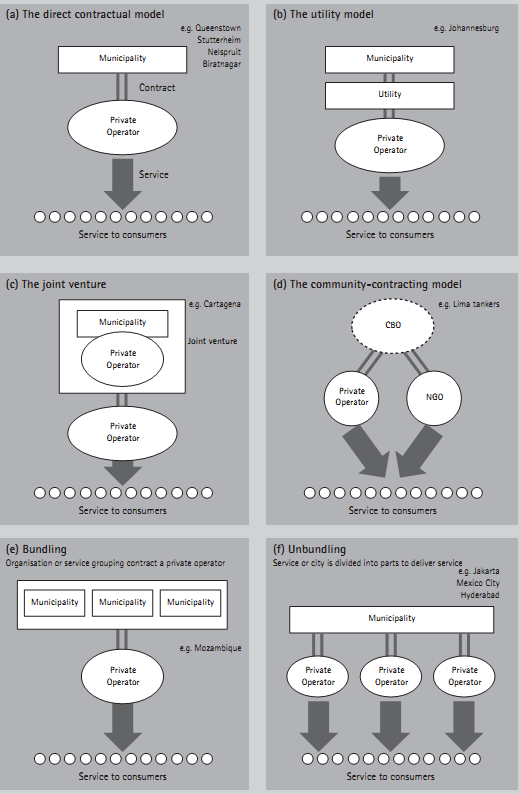
The first section, however, considers the organisational framework of municipal-private partnerships. In the light of an urban governance approach to public-private partnerships (PPPs) it is helpful to draw attention to these organisational options. They include joint ventures and independent corporatised utilities formed to manage (and perhaps finance) the service sector. The development of this organisational framework will form a primary part of the broader urban management objectives, and thus precedes a discussion on the delegation of service functions and the identification of contract types.
| Box 8.1 Structuring Partnerships |
|
|