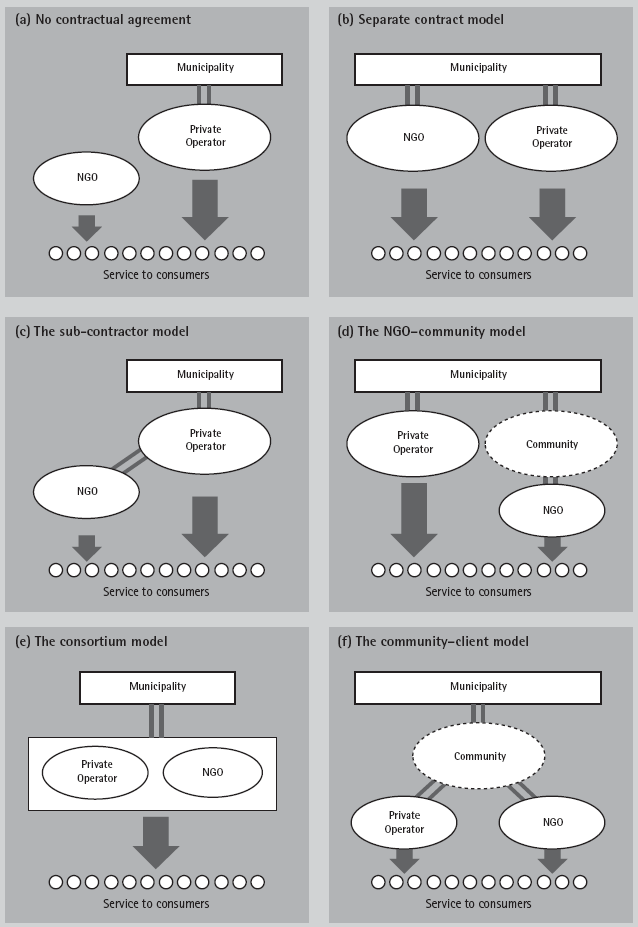
□ A separate contract
A second model (see Box 8.11(b)) creates a contractual relationship between the NGO and the municipality but retains a separation between the private sector and the NGO. Like the private sector, the NGO provides a service for some agreed remuneration.
This model is advantageous for certain reasons:
• the NGO is presumably contracted for a payment;
• it has a formal contractual relationship with the municipality-client; and
• it is independent from the private sector, and its role in relationship to the community is not compromised or conflicting.
However, this arrangement can also create significant problems. The municipal-NGO contract arrangement may be significantly smaller than the municipal-private sector contract. The lack of any formal arrangement between the private firm and the NGO means that the NGO can be marginalised at the discretion of the other partners. The degree to which the private firm takes on board the NGO advice is dependent on the municipality, and in particular on the private operator's contractual obligations in relation to the NGO. The NGO is not a partner of the primary (lead) provider, and depending on the NGO role, the private firm can bring its own contractual provisions to bear (e.g., any exclusivity clauses) on the NGO's activities.
Depending on the responsibility a municipality wishes to delegate, the municipal-NGO contract is often a service or a management contract. In some instances it may be a franchise (as is seen with the franchising of toilet blocks in India, and water kiosks in various parts of Africa).
Box 8.11 Contracting NGOs
|