■ Managing implementation
The overall concern of managers involved in partnership implementation should be the promotion of key principles such as accountability, competition and transparency that underlie the partnership. Trust and transparency are crucial if the parties are going to work effectively as partners on a sustainable basis. All stakeholders should be aware of what is being done, how it is being done and why.
Trust and transparency can only be fostered if procedures and systems for awarding and operating partnerships are acknowledged to be fair and clear, and it is the municipal manager's responsibility to put such procedures in place. Central among these is the process of choosing a partner. Municipal managers must be able to create trust with all potential partners (tendering operators, NGOs, CBOs) as well as public stakeholders. This kind of trust does not appear overnight. It requires forethought, honesty and openness among those who lead the process. It requires openness of information and constant dialogue.
Municipal management will also take the lead in the appointment and supervision of external consultants. The actions of a municipal manager who has taken the initiative to hire external advisors will largely shape how others work with that external agent. A municipal manager who has instigated the process of finding and funding a strategy or transaction advisor is likely to be a good listener, able to act on advice and contribute to the development of effective solutions. This sends a strong message to other municipal staff that cooperation is essential, and that the advice is respected and wanted.
The role of councillors in forums established for managing municipal partnerships cannot be overemphasised. It is not enough to have councillors who sit on decision-making boards but do not understand the principles, mechanics and key issues of the partnerships. Councillors should play a primary role in determining the objectives and character of the partnerships being established. Best practice suggests that councillors are most effective when they understand the detail of the partnership, although not all will wish to do so (see discussion in Chapter 11). Consistency (a low turnover) in the post of the chairperson for public works, capacity building more generally across the councillors in the partnership (especially for new councillors), and effective channels of communication to the partners and the council decision-makers are all essential in bringing about effective political leadership.
As partnerships proceed and evolve, a common problem in municipalities is that management is unable to assess realistically the potential value and commercial viability of the partnership. Most managers have only a limited familiarity with service measurement and performance assessment. Poor contract supervision often arises because the correct procedures and performance indicators were not established at the outset. This results in a lack of contract monitoring in relation to key objectives and corporate strategy and, in turn, leads to an inability to address issues of non-compliance and revise contract arrangements. Managers must take care to ensure that they are aware of staff performance, and especially that staff are appropriately skilled to perform the role of technical liaison with the private operator.
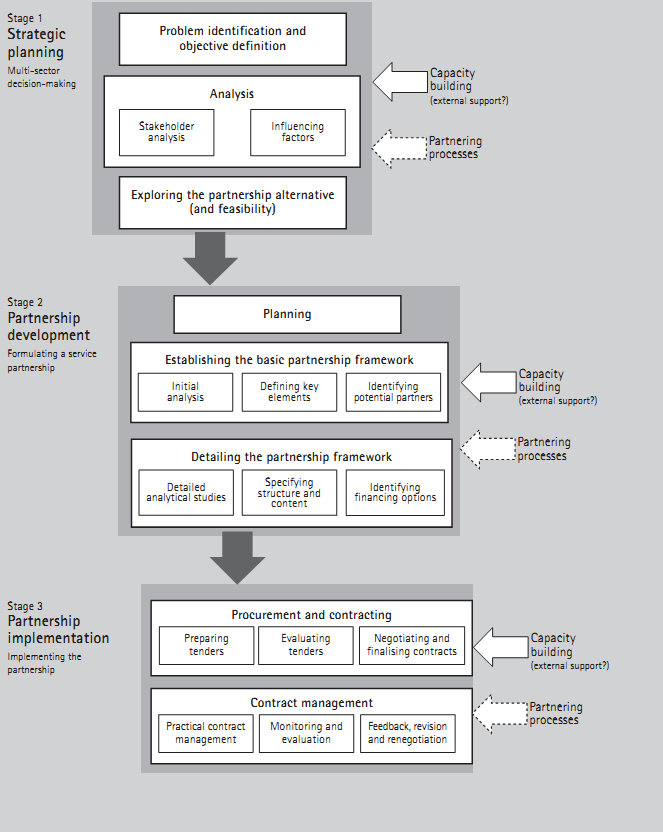
| Box 12.3 Establishing and Sustaining Effective Partnerships Primary Stages |
 |