Administrative Boundaries of Partnerships
3.10 A range of partnerships were identified in the returns, working from local to regional and international level. However, as illustrated in Figure 2 below, the great majority of partnerships identified (425 or 87.3%)18 could be categorised as operating at either District Council, sub-regional or regional level.
Figure 2
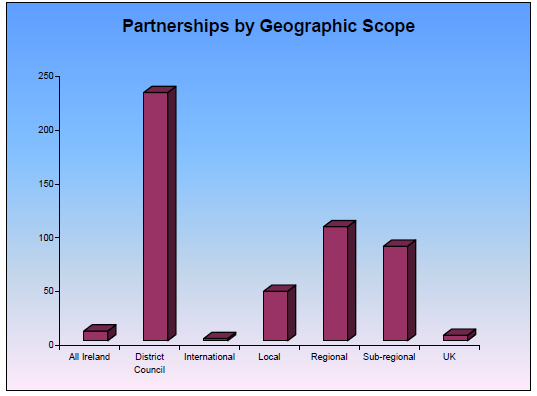
3.11 In the majority of cases, the administrative boundaries of partnerships which operated at the sub-regional level, reflected those of either a number of district councils (i.e. the North West Stakeholder Alliance) or relevant NDPBs such as Health and Social Services Boards/Trusts (i.e. Armagh and Dungannon Health Action Zone). This would suggest that there is a very clear relationship between the administrative boundaries of partnerships and those of government and the relevant executive bodies through which government policy and services are implemented and delivered.
3.12 To a large extent this may be explained by the concept that co-terminosity of boundaries between agencies and local authorities is an important precursor for successful co-ordination at partnership level.19 In this regard, the Review of Public Administration (RPA) consultation document acknowledged concerns that the lack of common boundaries for many of the public bodies which have to work together … makes planning and co-operation between them difficult.20 Indeed RPA concludes that the establishment of common boundaries is required to improve services and coordination.
3.13 In light of this, and taking account of the findings outlined above, RPA proposals, particularly for local government in Northern Ireland, both in terms of the number of councils and their role, are likely to have a significant impact on the great majority of partnerships identified in the returns. Implementation of these proposals may significantly change the administrative boundaries of local government and a number of NDPBs. Recognising the perceived benefits of working within a framework of community planning and common administrative boundaries this model provides the opportunity to create more effective and strategic partnerships.
_________________________________________________________________
18 Information regarding administrative boundaries was not available for a number of partnerships. The percentage figure quoted here takes account only of the 487 responses which provided information on administrative boundaries.
19 Deloitte MCS Limited, Mid-Term Evaluation of Local Strategy Partnerships: Stage II Summary, Jan 2005
20 DFP, The Review of Public Administration in Northern Ireland - consultation document, 2003, p15