Table 3. Major changes in the new PPI law
| Previous law | New PPI law |
Concession types | BTO, BOO | Unsolicited projects: BTO, BOT, BOO Solicited projects: No limitation |
Feasibility study | No requirement | Mandatory |
Fiscal support | Fragmentary recognition | Systematic support system: - Recognition criteria for unsolicited projects set out in the decree - Minimum revenue guarantee - Foreign exchange risk guarantee - Recognition of buyout rights |
Support agency | - | - Establishment of PICKO and the Infrastructure Investment Fund |
Source: Jungkyu Lee, "Regulations of PPI Act", paper presented at the Workshop on Private Participation in Infrastructure, (KRIHS, 2002).
About four years have passed since the new PPI programme was launched. It seems that the renewed efforts of the Government to promote PPI in the Republic of Korea have been successful. The results to date are quite impressive. So far, in the transport sector 37 projects have been promoted by the central Government and another 92 projects by municipal governments. A significant amount of foreign investment has been attracted; contracts worth $ 300 million have been signed, and contracts worth another $ 3.2 billion are expected to be signed soon. Construction of most of the projects for which a concession agreement has been signed has already started.
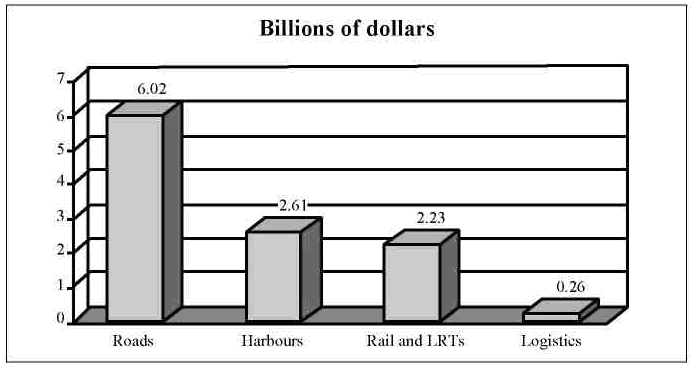
Contracts of over $ 13 billion with both domestic and foreign capital have been awarded. Of these, 15 transport projects of the central Government with investments of $ 11.1 billion accounted for the lion's share of the total investment. Local governments have signed concession agreements for 63 projects of worth $ 2.1 billion. Figure 1 shows the subsectoral distribution of these projects in the transport sector.
Source PICKO
Figure 1. Investment in contracts awarded projects by the central Government (as at November 2002)
In addition to the new projects, measures have been taken to revive projects for which concessions were granted earlier under the old PPI regime. Concessionaires designated under the previous PPI law were given a chance to renegotiate their concession agreements based on the new PPI law in order to take advantage of more favourable conditions now available. Table 4 shows some examples. In all five projects, either a new minimum revenue guarantee was provided or the level of the previous guarantee was increased from 80 to 90 per cent. The minimum revenue guarantee provision lowers the risk borne by the concessionaire through a government guarantee of projected revenue. Almost every project renegotiated under the new PPI law had a higher internal rate of return (IRR) and some projects benefited from additional government subsidies.