What kinds of partnership?
33 Partnerships vary in size, service area, membership and function. They include voluntary and statutory partnerships; executive and non-executive partnerships; strategic service delivery partnerships; and strategic partnering for private sector procurement, including PFI, PPP and joint ventures, such as NHS local improvement finance trusts (LIFT).
34 Some partnerships are strategic, others are operational in focus; some partnerships attract dedicated funding, others do not. Some are limited companies; others are charitable trusts and still more are unincorporated associations. We can also categorise partnerships by their region or locality, their function, their governance arrangements or their membership. The governance arrangements for different forms of partnership working are determined by their legal form. We have published more on this on the Improvement Network website at: http://www.improvementnetwork.gov.uk/imp/core/page.do?pageId=10310.
35 The 2000 Local Government Act sets out a coordinating role for the local strategic partnership (LSP) in preparing the local community strategy. LSPs play a key role in modern area-based partnerships and in effect are increasingly the umbrella under which all other partnerships operate. Almost all local authority areas have established an LSP; the exceptions being some county councils which have taken a collective decision to support the district council LSPs instead.
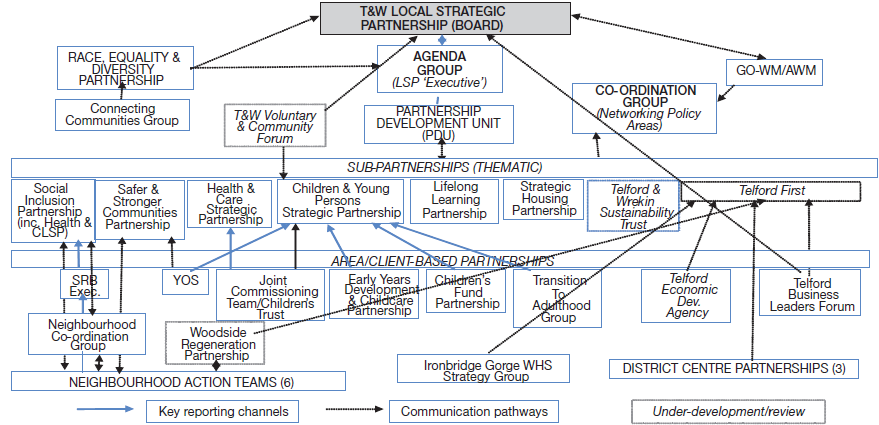
36 The local partnership landscape is getting more complex, as seen in Figure 2. This diagram does not represent a typical LSP, which vary considerably in structure and membership. However, it does illustrate the common complexity of nested partnerships within an LSP. It is not the total picture; some operational partnerships exist outside the LSP umbrella and have done for some time.
37 Is it possible to manage all these collaborations successfully to produce benefits that public bodies could not achieve by other means? The Office of the Deputy Prime Minister (ODPM) recently published evidence to show that some progress has been made, but also that there is still some way to go (Ref. 5). The Commission's own evidence from its work with LSPs in Neighbourhood Renewal Fund (NRF) areas is that:
'A common issue for many LSPs has been the lack of any clear and effective relationship between LSP boards and thematic partnerships, including the development of processes for reporting performance information to Boards.'
(Ref. 6)
38 To date, most partnerships have paid a lot of attention to establishing good working relationships and this is important in making partnerships work well. But the complexity illustrated in Figure 2 shows that concern with process is not enough; public bodies need to give more thought to the risks that partnership working brings and the consequences of failure.
Figure 2 The local partnership landscape is getting more complex. |
TELFORD AND WREKIN PARTNERSHIP: CURRENT (7/05) ORGANISATIONAL STRUCTURE |
|
Source: Telford and Wrekin Council, 2005 |