4.1 What is Risk?
In an ideal world, a project would be constructed on time and on budget, operating revenues and expenses would meet forecasted targets, and the quality of delivered services would meet everyone's expectations. Unfortunately, this is not always the case. Furthermore, other unexpected events - insolvency, failure by parties to perform as expected or as contractually required, site conditions or uncontrollable external events (wars, earthquakes, flooding, or fires) - can prevent a project from meeting expectations and leaving it's commercial viability and ultimate success in question.
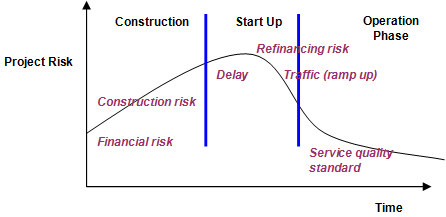
Risk is a concept that is used to express concerns about the probable effects of an uncertain environment and can be characterized by its probability of occurring and the magnitude, or effect, it would have on expected returns or outcomes should it occur. Every aspect of a project has risks (see Figure 4 - 1) and because the future cannot be predicted with certainty, all parties to a PPP must consider a range of possible events that could take place; each of these events potentially having a material effect on the project and its goals.
Risk analysis is the art of identifying those possible events, measuring them, prioritizing them, and then managing them. In fact, a key aspect of the PPP structure is its ability to help facilitate the transferring of risk to the party that is best suited to manage or minimize it.
Figure 4 -1
Project Risk 43
When considering risk, it is imperative to recognize that each party involved will have a different perspective and thus a different approach to risk assessment. Given the number of different parties to a project, this section will focus only on risk from a financier's perspective.
_______________________________________________________________________________
43 http://rru.worldbank.org/Documents/Toolkits/Highways/2_carac/22/224.htm