Users' views on quality
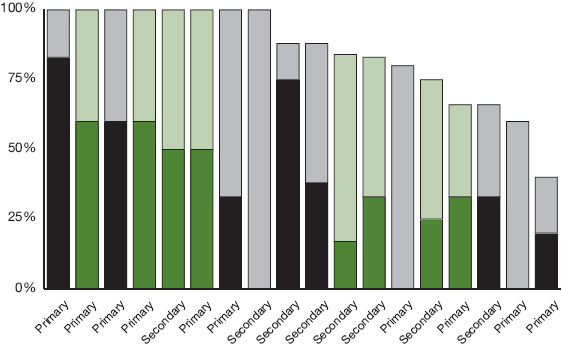
| 14 Users' views about new school buildings were explored through a questionnaire developed by CIC and administered by MORI. The questionnaire began by asking about overall satisfaction with the new building. Most users, irrespective of whether they were a pupil, teacher, governor or caretaker, were pleased overall with their new schools - across the whole sample the 'net satisfaction' level was 81 per cent. This is not surprising given the advantages of being in a modern building, compared with the probably dilapidated and outdated school it replaced. There were no statistically significant differences between PFI and traditionally funded schools, or between primary and secondary schools, in this overall satisfaction [Exhibit 3, overleaf]. 15 The questionnaire then asked whether users agreed or disagreed with 100 statements about specific aspects of their buildings' design and operation. Answers to these questions sometimes revealed lower satisfaction, but there were no statistically significant differences between the types of school on any of these measures:I • Meeting different needs: The majority of users were satisfied with such issues as signage, circulation and common areas, but lack of space was mentioned as one of the most frequent reasons for dissatisfaction with the building. Access for wheelchair users was judged satisfactory, but few agreed that the buildings would meet the needs of those with impaired sight or hearing. A majority of users thought that their buildings were adaptable to changing needs. • Look and feel: The majority of users agreed their schools offered a positive image (for example, their building 'contributed to the neighbourhood'; it 'lifted the spirits'). By contrast, fewer agreed that environmental aspects such as temperature control, ventilation and acoustics were good. • Construction issues: These questions covered perceptions about building faults, 'cleanability' and durability. The majority of school users agreed that their schools were easily cleaned and maintained. |
| Exhibit 3 |
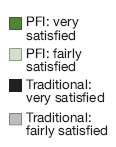
| Most users, irrespective of whether they were a pupil, teacher, governor or caretaker, were pleased overall with their new schools. There was no statistically significant difference between PFI and traditionally funded schools. |
| Users satisfied with their new school building |
Source: MORI survey of 94 users of eight PFI (35 users) and ten traditionally funded schools (59 users), using an interview questionnaire based on a design evaluation tool developed by CIC |
|
__________________________________________________________________________________
I This was the case whether using the net agreement score for the users of a school as a whole (N = eight PFI and ten traditional schools), or using the individual users as the base (N = 35 PFI school users and 59 traditional), or selecting only the headteachers (N = eight PFI and eight traditional).