Environmental control
| 17 Failures here are particularly worrying, since fundamental aspects such as the quality of the lighting, temperature and ventilation control, and acoustics directly impact on day-to-day learning conditions [Box C]. Most of these are areas where users expressed least satisfaction - with only a minority agreeing, for example, that the temperature was appropriate in all seasons, despite users rating this as one of the most important environmental factors. On the other hand, despite the technical assessment calling into question the quality of light, a majority of users were satisfied with this aspect. However, for those schools where the users did express reservations, the technical assessment also tended to be lower. |
| Box C |
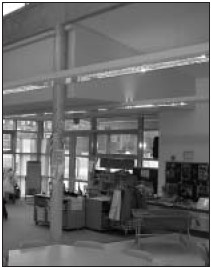
| Poor daylight and summertime environment. BRE noted that 'no school was visited which did not have the vast majority of its artificial lighting switched on'. For example, in one PFI school low window height severely limited daylight penetration to less than 15 per cent of the school hall width. The occupants' solution was to leave artificial lighting on all day. In the summer, hot air collected at ceiling level and could not escape. The ceiling then became a large radiator and added to discomfort from overheat. One way to avoid both problems would have been to ensure that there were high level opening windows. A second PFI school was, by contrast, one of the best schools for quality of daylight, which was adequately and uniformly distributed throughout the classrooms by clerestory lights. The latter were positioned to bounce light off the back wall of the classroom (as shown in the photograph). Source: BRE |