The cost of PFI schemes compared with the PSC
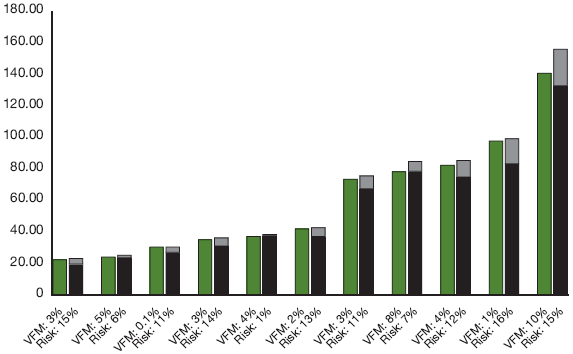
| 57 Findings from our sample of early wave school schemes suggest that the differences between the PFI solution and the PSC varied but were often low. In every case PFI was judged to offer a saving, ranging from 0.1 to 10 per cent of the total scheme cost [Exhibit 8]. Similar findings have been reported before, for example, for school PFI schemes in Scotland (Ref. 10). These findings would suggest that the VFM of school PFI has already been proven. But the report by Audit Scotland raised doubts as to whether this was in fact the case, and our findings are consistent with this. The PSC has excited much technical debate - the issues have been well set out in a range of reports and academic papers (for example, Ref. 11) and some arose during the fieldwork for this study, including: • Some economists stated that the PSC methodology overestimated the cost of borrowing for councils. Others disagreed and claimed that the cost of public sector borrowing was in fact higher than often stated, because it involved hidden costs, and therefore that this criticism of the PSC was unfounded. • If a PFI scheme's costs were not lower than the PSC estimate, it was unlikely to receive permission to proceed, and the opportunity to obtain new buildings or refurbishment would have been lost. Some interviewees claimed that the incentive to estimate on the high side for the PSC in order to obtain the government funding was strong. We could not validate this view, but it was the case that in all but two schemes in our sample the cost advantage of the PFI option relied on the estimate of the cost of risks transferred. And the size of risks transferred was related to the difference between the PFI cost and the PSC estimate - where the PSC estimate of construction and running costs was much below the PFI cost, the cost of risk transfer added on was on average higher [Exhibit 8]. Again, similar results were found for the school schemes in Scotland.I |
| Exhibit 8 Estimates of the costs saved by using PFI rather than traditional procurement for a sample of school schemes, according to calculations via the Public Sector Comparator (PSC); and the value of risks transferred The costs of PFI schemes were often close to the PSC, but in every case PFI was predicted to offer a saving, ranging from 0.1 to 10 per cent. The size of risks transferred was related to the size of the difference between the PFI cost and the PSC estimate. |
Source: Audit Commission sample | £million
Schools PFI Schemes |
__________________________________________________________________________________
I In five out of six Scottish school PFI schemes, construction costs were higher than the PSC, and in all six cases the operating costs were higher under PFI - but the risk adjustment tipped the balance back in favour of the PFI schemes. In some schemes, each type of risk had been carefully identified, and cost estimates had been rigorously analysed and documented. But in others, the validity of the risk calculations was not clear and the size of risk transfer (for example, equivalent to 20 per cent of total costs) was considered by Audit Scotland not to be plausible (Ref. 10).