E. Public-Private Partnerships Encourage Innovations and Incorporation of Life-Cycle Costs which Leads to the Delivery of a Higher Quality Transportation Facility
In contrast to traditional contracting methods, public-private partnerships have more flexibility to maximize the use of innovative technologies that will lead to increases in quality and the development of faster and less expensive ways to design and build highway facilities. This section examines the benefits that can occur when contractors are given greater flexibility to employ innovative materials and techniques.
The traditional contracting approach has limited opportunities for contractors to incorporate innovative materials and techniques in the design and construction of transportation projects. The Federal government and many State governments have constraints on their procurement methods that have the unintended result of limiting access to new technologies and techniques. "Lowest price" on bids is often required, even when "best value" would be a more effective approach. Restrictions on the participation of Federal funds in payment for premiums or royalties on patented or proprietary material limits a State's ability to use newer technologies on projects.[105] Outside of government procurement, the private sector is not constrained by these laws and regulations.[106] The private sector also has access to product and trade secrets available to the public sector, and these can be quickly and easily incorporated into public-private partnerships.[107]
Innovative contracting methods often give the contractor additional freedom to decide the best method and material for the project, while the State highway agency provides the direction on the performance, schedule and cost.[108] Greater flexibility and less rigid prescriptive specifications give the contractor freedom in other areas of the project.
The departure from the traditional contracting approach allows designers and builders to take advantage of the advances in technologies and techniques relating to construction materials, equipment, and design methods.[109] These innovative techniques and materials improve the quality and reduce the duration of the construction project, and normally result in lower life-cycle costs.[110]
Quality is difficult to measure in highway construction because of the unusually long life of the asset being constructed. Public-sector partners can measure quality over the life of an asset but quality is difficult to gauge immediately after the road is constructed. Both the Wisconsin DOT and the Construction Industry Institute have studied innovative contracting and its impact on quality. The Wisconsin DOT explored the relationship between quality and whether or not the project had a warranty. As Figure 3.4 demonstrates, warranted pavements performed significantly better.
Figure 3.4
Quality between Warranted and Non Warranted Projects in Wisconsin[111]
Performance Indicators | Pavement Age | |||
New | 1 year | 2 years | 3 years | |
State Average IRI - Non Warranted | 1.00 | 1.12 | 1.29 | 1.36 |
Average IRI - Warranted | 0.80 | 0.83 | 0.79 | 0.80 |
State Average PDI - Non Warranted | 0 | 4 | 11 | 18 |
Average PDI - Warranted | 0 | 2 | 5 | 8 |
The Wisconsin DOT study indicates the warranted pavements are performing better than similar non-warranted pavements based on the measured International Rough Index (IRI) and Performance Distress Index (PDI). The IRI is an indication of surface smoothness and is measured in inches per mile or meters per kilometers.[112] A PDI of "0" indicates a pavement in perfect condition and "100" represents the worst condition.
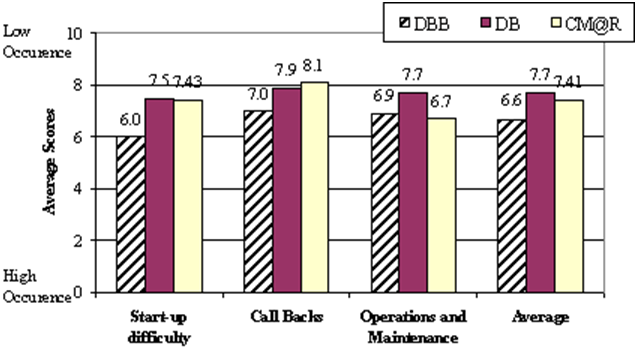
A study by the Construction Industry Institute compared three project delivery systems for the construction of several different types of buildings and measured their quality.[113] The first was the traditional design-bid-build (DBB) system and the next two were innovative approaches giving the contractor greater flexibility (design-build (DB) and construction management at risk (CM@R)). Construction management risk is similar to the traditional design-bid-build method in that there is a separate design and construction firm; however, there is an intended integration of effort between these entities.[114] Figure 3.5 shows the results of this study in which innovative building approaches consistently scored higher for quality than traditional procurement.
Figure 3.5
Innovative Building Approaches v. Traditional Procurement[115]